
A Holistic Progress Card tracks a child’s overall development across academics, skills, behaviour, co-curricular activities, and socio-emotional growth, while helping teachers report this progress to parents and other stakeholders.
Key Takeaways
- Holistic Progress Cards go beyond marks to track a child’s overall development and individual learning journey.
- They capture academic progress along with skills, behaviour, creativity, co-curricular participation, and socio-emotional development.
- Holistic assessment helps teachers understand what students are learning, how they apply it, and where they need support.
- Continuous progress tracking can help schools identify learning gaps and provide timely intervention.
- Digital classroom solutions and school ERP software can help schools organize student data and generate holistic progress reports more efficiently.
Traditionally, student assessment was all about a piece of paper. A report card with grades and numbers was all we needed to gauge if a student was doing well or not. But today, education is a lot more than just that.
Today’s students don’t have to just score marks. They develop creativity, digital skills, collaboration, emotional intelligence, and more. And that’s where Holistic Progress Cards come in!
Holistic Progress Cards mark a significant transformation in how teachers evaluate students, and parents keep a tab on their child’s academic journey. Its focus goes beyond marks in examinations to look at the pupil’s academic, co-curricular, and socio-emotional growth.
Notably, this form of student assessment also aligns with NEP 2020 and its vision to make learning personalized and flexible.
How does it apply practically?
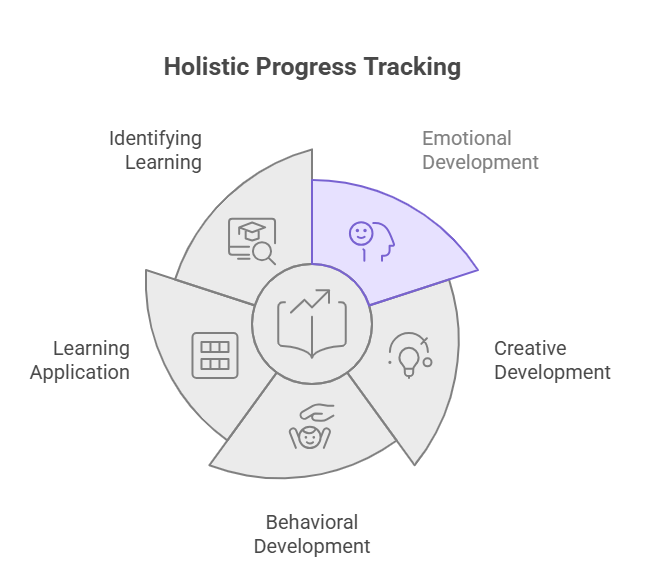
In simple terms, holistic progress tracking is about developing every aspect of the student’s personality. These include emotional development, creativity, behavioural traits, learning application, and more.
- Traditional progress cards measured only scores, while this new method tracks student growth at many different levels.
- Holistic assessment is about identifying what a student is learning and how they apply that learning.
- The emotional, creative, and behavioral development of each learner matters.
The Transformation in Student Assessment and Examinations
By now, you must understand that the focus of holistic report cards is multi-dimensional.
Here’s what the shift means:
1. Meaningful Learning
When it comes to holistic progress cards, students are assessed on a range of fronts. These include:
- Conceptual understanding and analytical ability are in focus when measuring a student’s academic performance.
- Participation in arts, sports, and co-curricular clubs is valued in the assessment.
- Thirdly, behavioural skills are also valued, including teamwork, leadership, and empathy.
- Lastly, the socio-emotional growth of students is also measured by resilience, adaptability, and communication.
2. Boosting Teacher-Parent Collaboration
Holistic progress cards offer detailed insights about the student. Hence, parents get to learn more about their child’s learning style while teachers can use the received feedback to tweak the teaching methods to suit every child’s growth.
3. Examinations Redefined
The traditional examination method of student assessment inspired a bit of fear in students, as their entire performance depended on one day, i.e., the examination date.
Holistic progress cards, on the other hand, focus on continuous evaluation that tracks a student’s performance throughout the academic year.
In a nutshell, holistic assessment guides a student’s learning, while traditional assessment was a ‘single day’ determining process.
4. Holistic Assessment Backed by Technology
Implementing holistic assessment in every school can’t be done manually (as it can consume incredible amounts of time and energy). And that’s where technology comes to the rescue with digital classroom solutions and school ERP software.
5. Centralized Data with School ERP Software
School ERP software stores and organizes a variety of student data on a single platform. This includes attendance data, skill assessments, grades, and co-curricular participation.
As a result, schools can maintain accurate digital records for every student. Naturally, this helps them in generating holistic progress cards with ease, too. Furthermore, teachers, students, and parents can access the student’s performance data in real-time.
6. Smarter Classes and Smarter Assessment
Digital classroom solutions make way for continuous and interactive assessment for every student. This is made possible thanks to tools such as online assignments, AI-driven analytics, and interactive quizzes, which teachers can use to track learning outcomes on an everyday basis.
- Teachers can timely identify learning gaps in every student’s performance.
- Teachers can monitor student performance in real time.
- Lastly, educators also get to offer instant feedback, supported by updated data.
7. Transparency and Accessibility
Thanks to technology, student assessment becomes accessible, consistent, and transparent for each stakeholder. For example, parents can monitor their child’s progress whenever they wish to, while students can also set personal learning goals.
In a nutshell, technology makes holistic assessment in teaching seamless for everybody.
Key Features Of Holistic Progress Cards
Holistic Progress Cards are made in such a way as to reflect the student’s journey. This includes everything from their academic performance to their overall personality.
Here are some of its important features:
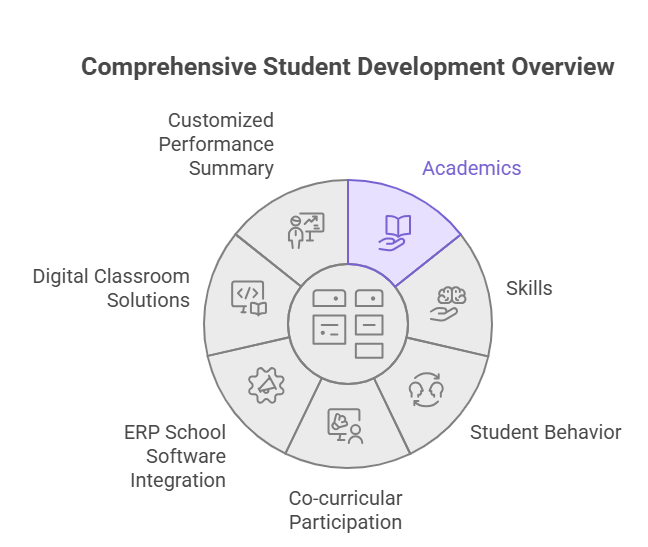
- Holistic Progress Cards focus on the full range of development areas in a student. These include academics (knowledge, reasoning, creativity), skills (leadership, collaboration, and problem-solving), student behaviour (empathy, responsibility, and respect), and co-curricular participation.
- When merged with ERP school software and digital classroom solutions, holistic progress cards turn dynamic and interactive. This seamless integration helps schools in automated data collection and organization, continuous progress tracking, and real-time insights for parents and teachers.
- Lastly, this allows teachers to give a customized performance summary for each student. As a result of this feedback, students also become self-aware, while teachers design lesson plans that are tailored for timely intervention to improve learning outcomes.
- Also, ERP school software and digital classroom solutions keep the parents informed and involved in their child’s learning process.
The Road Ahead
Moving on, student assessment in India is transforming at a rapid pace. It is becoming student-centered, digital-driven, and backed by accurate and real-time data.
Currently, NEP 2020 is also continuing to guide schools towards this revolution in education and assessment. Moreover, holistic progress cards are going to play a central role in turning the education models into learning-centric, rather than outcome-centric.
Here’s what will follow:
- Personalized learning analytics backed by AI.
- More innovation in digital classroom solutions.
- Integrated ERP systems that integrate assessment, academics, and attendance.
- Automated grading and smart dashboards to help teachers optimize teaching methods.
Building a Learning Culture Ready for the Future
In summary, holistic progress cards are much more than traditional report cards. They reflect how a student’s educational journey is transforming. By integrating life skills, creativity, academics, and emotional intelligence, this system will nurture well-rounded individuals who are ready for the challenges of the future.
With tools such as ERP school software and other digital classroom solutions provided by industry leaders like NAVNEET TOPTECH, schools can bring this vision to life in real-time. And our country can expect a future filled with confident students, well-informed teachers, and smarter classrooms throughout the nation.
FAQs
Q1. What is holistic assessment?
Holistic assessment is an approach to evaluating students beyond academic marks. It considers what students learn, how they apply their knowledge, and their development across skills, behaviour, creativity, collaboration, and socio-emotional areas.
Q2. How do Holistic Progress Cards help identify learning gaps?
Holistic Progress Cards bring together different aspects of a student’s performance, helping teachers identify areas where a learner may need additional support. When supported by continuous assessments and digital data, teachers can track learning gaps, provide timely feedback, and plan appropriate interventions.
Q3. How are Holistic Progress Cards different from traditional report cards?
Traditional report cards generally focus on marks, grades, and academic performance. Holistic Progress Cards provide a broader view by including academic progress alongside skills, behaviour, co-curricular participation, and socio-emotional development.
Q4. How does technology support Holistic Progress Cards?
School ERP software and digital classroom solutions can help schools collect, organize, and track student data such as assessments, attendance, skills, and participation. This makes it easier for teachers to create detailed progress reports and share relevant insights with parents.