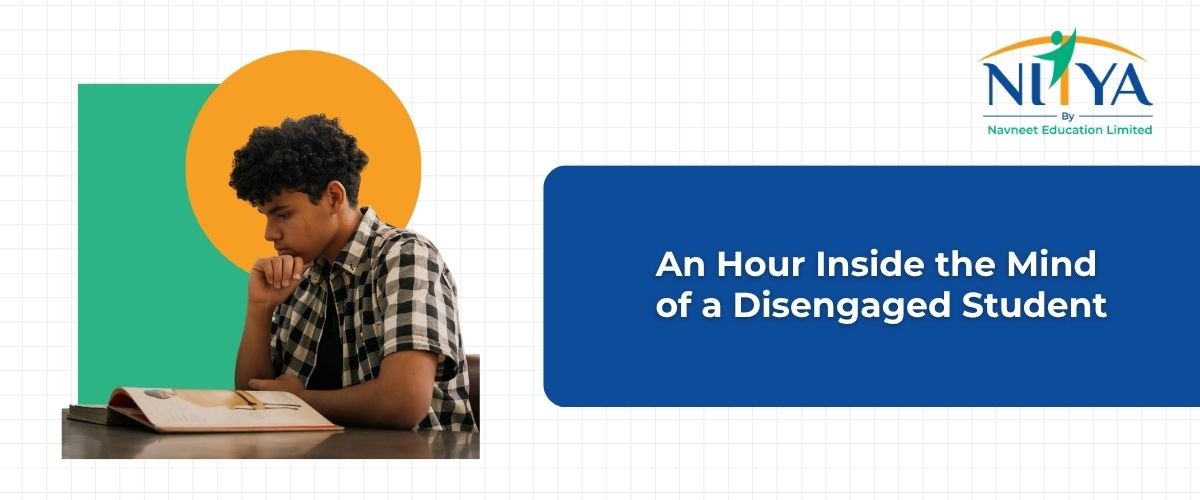
Meet Ishaan. He is twelve years old, Class 7, third bench from the left. His attendance is fine. His behaviour is fine. His marks are average. To most of his teachers, he is unremarkably present but invisible. What follows is one hour inside his head during a History lesson. Read it carefully. Because Ishaan is in every classroom in India.
9:05 AM – Sir has started talking about the Mughal Empire. Again. I read about this in Class 6. I wonder if he knows that. He’s drawing a timeline on the board. I already know Akbar comes after Humayun. My grandfather told me stories about Fatehpur Sikri once. That was interesting. This is not interesting. I wonder what’s for lunch.
9:18 AM– He asked a question. Priya raised her hand immediately. She always does. He called on her. She got it right. He said “very good.” Nobody else’s hand went up because nobody else wanted to look stupid if they got it wrong. I knew the answer too. I didn’t raise my hand. What’s the point?
9:31 AM-He’s still talking. I’ve been looking at the wall for six minutes. There’s a crack near the top that looks like a river on a map. I wonder which river. Maybe the Godavari. I like rivers. I don’t know why we’re not talking about rivers right now. Rivers actually go somewhere.9:44 AM-He just said “Is everyone following?” Everyone nodded. I nodded too. I have not been following for the last twenty minutes. I don’t think he noticed. I don’t think it matters.
Ishaan is not a problem student. He is a symptom. He is what happens when a classroom is designed for content delivery rather than human engagement, when the measure of success is “did I cover the chapter?” rather than “did anyone actually learn something today?”
What disengagement is really telling us
The tragedy of students like Ishaan is not that they are incapable. It is that they are capable of far more than they are ever asked for. His mind is curious, it went to Fatehpur Sikri, to rivers, to patterns in cracks on walls. That is not a distraction. That is an active intelligence looking for something worth attaching itself to. The classroom just never offered it anything.
Under NEP 2020’s vision of competency-based, experiential education, this is precisely the problem schools are being asked to solve. Not by entertaining students, but by designing learning experiences that give curious minds somewhere meaningful to go.
Now imagine the same lesson differently
9:05 AM– Sir asked us to look at a map and find three places the Mughal Empire never reached. I found one immediately near the coast. Rohan found one in the south. Sir asked us why we thought those places stayed independent. I have an idea. I actually have an idea. I raise my hand.
Same topic. Same teacher. Same Ishaan. The only thing that changed was the design of the first five minutes.
What makes the difference
1. Questions before answers. Start with a problem, a puzzle, or a provocation not a lecture. Curiosity must come before content.
2. Low-stakes participation. Think-Pair-Share, anonymous response slips, small group discussion structures that let every student think out loud without fear of being wrong in public.
3. Connect to what students already know. Ishaan had a story about Fatehpur Sikri. A teacher who asked “has anyone been to or heard of any Mughal monument?” would have found him immediately.
4. Choice in how students respond. Not every child expresses understanding through a written answer. Give students multiple ways to show what they know.
5. Make the learning visible. Exit tickets, class discussions, quick sketches, anything that makes a student’s thinking visible to themselves and their teacher.
“Every disengaged student is a question the classroom hasn’t answered yet: why does this matter to me?”
Teachers cannot design for engagement they haven’t experienced themselves
Here is the uncomfortable truth: many teachers were themselves taught through rote methods. They learned to sit, listen, memorise, and reproduce. Asking them to design active, engaging classrooms without structured training and support is like asking someone to cook a meal they’ve never tasted.This is why teacher professional development that focuses specifically on engagement strategies, active learning design, and classroom observation is so critical. It doesn’t just give teachers new techniques. It changes how they see students and how students, like Ishaan, begin to see themselves.
Every classroom has an Ishaan. Give teachers the tools to reach him.
Explore – NITYA