

Key Takeaways
- Learning management systems help schools organize educational content, assessments, communication, and academic progress.
- LMS benefits for teachers include easier assessment management, timely feedback, and better visibility into student performance.
- An LMS can improve student engagement through interactive content, regular feedback, and self-paced learning.
- A learning management system for schools can connect teaching, assessment, and academic management in one platform.
Modern classrooms are evolving rapidly, and teacher-student collaboration plays a key role in effective learning. A Learning Management System (LMS) bridges this gap by creating connected, interactive, and engaging learning environments. In this blog, we’ll explore the benefits of LMS for schools and how it strengthens collaboration between teachers and students.
One such technology is the Learning Management System, or LMS. It’s a digital platform that organizes, delivers, and tracks educational content and classroom interactions.
In this blog, we’ll explore how LMS platforms improve collaboration, deepen engagement, and ultimately make learning more personal, dynamic, and outcome-oriented.
Why Teacher-Student Collaboration Matters in Modern Classroom
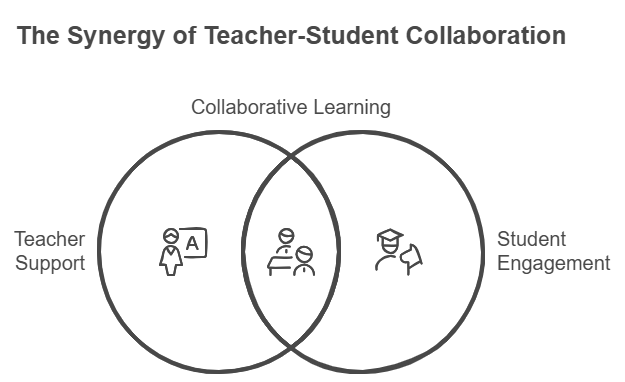
Effective learning isn’t just about delivering content; it’s about building a two-way relationship between teachers and students. Collaboration ensures that learners feel seen, heard, and supported, which, in turn, improves participation, understanding, and academic motivation.
Consider this: a student struggles with a math concept but hesitates to raise a hand in class. The teacher, unaware, moves on. Days later, the knowledge gap grows. Now, imagine this: the LMS dashboard flags that a student scored significantly lower than usual on a recent quiz (digital tests completed after each topic). The teacher sees this real-time alert and schedules a one-on-one session with the student before the next class. This timely intervention helps address the confusion early, before it snowballs into a learning gap.
This is the power of collaboration, timely, personal, and rooted in trust. When learners feel seen and supported, they are more likely to engage deeply with content. Likewise, when teachers understand their students beyond report cards, they can guide them with empathy and precision.
What Are the Benefits of LMS for Teachers?
A learning management system helps teachers organize resources, manage assessments, and monitor academic progress efficiently.
- Organized Resources: Keep lesson materials and assignments in one place.
- Easy Assessment Management: Simplify quizzes, assignments, and records.
- Progress Tracking: Identify learning gaps through reports and dashboards.
- Timely Feedback: Help learners understand areas for improvement.
- Efficient Workflows: Reduce repetitive tasks and save time for teaching.
Top Ways LMS Supports Teacher-Student Collaboration
Built on traditional pedagogical frameworks, an LMS consolidates lesson plans, assessments, student data, feedback loops, and communication tools, all within a single digital interface. This consolidation allows educators to spend less time managing logistics and more time engaging with learners.
Platforms like NAVNEET TOPTECH’s TopSchool LMS are purposefully designed with these needs in mind. With features such as customizable dashboards, instant performance tracking, and integrated communication tools, they empower teachers to respond to student needs faster, facilitate one-on-one support, and manage class workflows more efficiently.
Key ways an LMS enhances teacher-student collaboration:
- Centralized Communication: Teachers and students can exchange updates, instructions, and learning materials in one accessible space. With discussion forums, comment threads, or messaging options, students can clarify doubts and engage in conversations even outside classroom hours. Whether it’s a quick clarification or peer discussion, messaging features allow both students and teachers to stay connected outside the physical classroom, reducing hesitation and delays.
- Real-Time Feedback: Students receive instant responses on digital quizzes and assignments, allowing them to recognize and correct mistakes early. Teachers can identify learning gaps before they widen.
- Private Feedback Loops: Personalized comments on assignments or progress reports help students understand where they’re doing well and where they need to improve, without waiting for a parent-teacher meeting or final exam.
- Custom Learning Paths: Based on student performance, teachers can assign tailored resources, like supplementary videos or reading modules, so learners receive the right help at the right time, making learning more equitable and targeted.
- Analytics for Intervention: Dashboards provide visual insights into student engagement and achievement. Teachers can proactively intervene with support sessions, re-teaching, or enrichment activities.
Each of these tools not only streamlines teaching but also builds a classroom culture of open communication, responsiveness, and mutual accountability. Together, these features foster a sense of academic partnership, one where teachers can guide more effectively and students can participate more actively.
Benefits of LMS for Classroom Engagement and Student Motivation
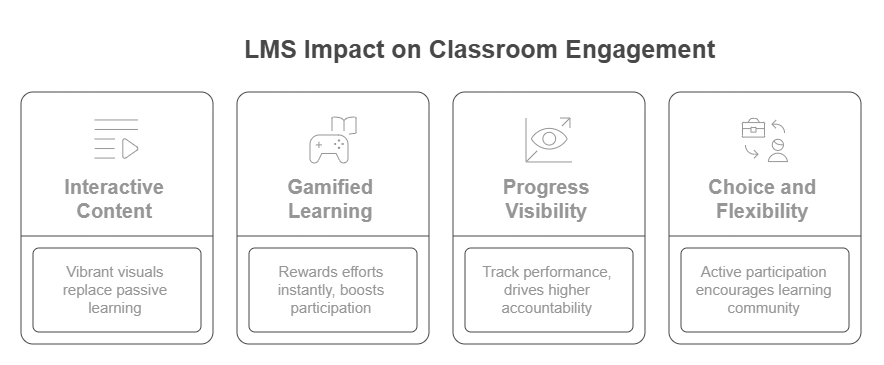
While collaboration strengthens relationships, engagement is what keeps students motivated and curious. An LMS can significantly enhance classroom engagement by introducing interactivity, autonomy, and a more student-centric learning environment. This is possible by transforming lessons into immersive learning experiences that meet students where they are: digitally fluent and eager for stimulation.
Here’s how:
- Interactive Content
LMS can host a variety of content formats, including videos, simulations, quizzes, and polls, making lessons more visually stimulating and less monotonous. The platforms replace passive learning with vibrant visuals, 3D models, interactive simulations, and real-world scenarios. For example, a biology concept like mitosis can be brought to life with animated explainer videos, making the abstract feel intuitive.
- Gamified Learning
Progress bars, digital badges, and classroom leaderboards introduce an element of healthy competition. When students see their efforts rewarded instantly, even routine quizzes become exciting. Gamification doesn’t just boost participation; it fosters a sense of achievement and progress.
- Progress Visibility
Students can track their performance and see how they’re progressing week by week. This sense of ownership drives higher accountability and goal-setting. Whether at home or in class, this flexibility enhances focus and reduces anxiety.
- Choice and Flexibility
LMS enables students not only to absorb information but also to contribute to it. Debating viewpoints, co-creating projects, and offering feedback. This active participation encourages a community of learners rather than isolated individuals. Allowing students to access content anytime, choose practice sets, or complete tasks at their own pace increases autonomy, which, in turn, boosts engagement.
Most importantly, LMS-driven classrooms encourage students to explore, experiment, and evaluate their progress. It develops a growth mindset, a cornerstone of long-term academic success.
Why Every School Needs an LMS
The question is no longer whether digital learning works; it’s whether schools are ready to scale it in ways that benefit both educators and learners. An LMS is not a luxury anymore; it’s a necessity for any institution aiming to deliver quality education with consistency and reach.
Here are some compelling reasons schools should adopt LMS platforms:
- Scalability and Standardization: Whether it’s one classroom or an entire school chain, an LMS ensures uniform delivery, standardized assessment, and consistent progress monitoring.
- Data-Driven Decision Making: With detailed analytics and real-time dashboards, school leaders and teachers can make informed decisions about interventions, curriculum pacing, and student support.
- Reduced Administrative Burden: Scheduling, attendance, homework collection, and reporting — all get streamlined, freeing up more time for teaching.
- Parent Involvement: Many LMS platforms come with parent dashboards that enable guardians to stay informed and involved in their child’s learning journey.
- Technology Integration: As NEP 2020 pushes for tech-integrated classrooms, LMS adoption positions schools to meet new compliance, curriculum, and pedagogical expectations seamlessly.
Building Connected Classrooms with LMS
In a world where education must be flexible, inclusive, and learner-focused, LMS benefits for students and teachers are too significant to ignore. By improving transparency, deepening student-teacher interaction, and creating more immersive classroom experiences, LMS platforms like TopSchool LMS by NAVNEET TOPTECH are setting the stage for truly connected classrooms.
And that’s the future of education: connected, collaborative, and deeply engaging.
FAQs
Q1. How Do Learning Management Systems Improve Teacher-Student Collaboration?
Learning management systems help teachers share learning resources, provide timely feedback, review assessment results, and communicate more effectively. These features support better coordination between teachers and learners.
Q2. How Can Schools Use an LMS to Improve Classroom Engagement?
Schools can use an LMS to provide interactive learning materials, digital quizzes, practice activities, and regular feedback. These tools help teachers encourage participation and make lessons more engaging.
Q3. How Can a Learning Management System Benefit Schools?
A learning management system helps schools organize educational resources, coordinate assessments, monitor academic progress, and streamline academic administration through a centralized digital platform.
Q4. Which LMS Features Should Schools Prioritize When Choosing a Platform?
Schools should prioritize learning content management, assessment tools, progress reports, communication capabilities, and administrative features. The platform should align with the school’s academic requirements and teaching workflows.