

Every day, thousands of teachers walk into classrooms carrying more than lesson plans, they carry unspoken exhaustion. Teacher burnout is not a personal failing. It is a systemic challenge that demands our collective attention, especially as India’s schools navigate the demands of NEP 2020.
What is teacher burnout and why does it matter now?
With the rollout of NEP 2020 and the rising expectations around competency-based learning, digital classrooms, and continuous professional development (CPD), the pressure on educators has never been greater. Recognising burnout early and addressing it systematically, is not just good for teachers. It is essential for student outcomes.
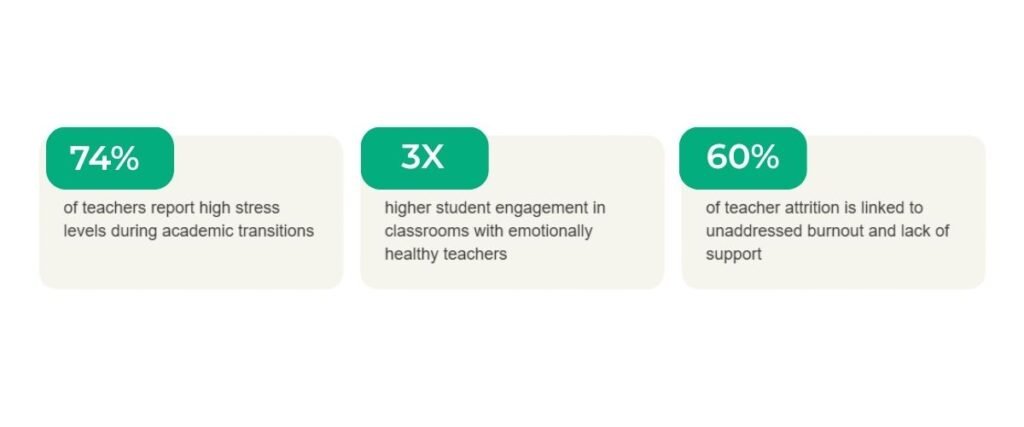
Warning signs that principals and teachers should watch for:
Burnout rarely announces itself loudly. It builds gradually, disguised as
fatigue, cynicism, or a drop in classroom enthusiasm. Here are the key warning signs for both teachers and school leaders to recognise:
Emotional exhaustion: Feeling drained before the school day even begins; dreading Monday mornings.
Depersonalisation: Becoming emotionally detached from students, treating them as tasks rather than individuals.
Reduced sense of accomplishment: A persistent feeling that efforts are pointless or unnoticed.
Physical symptoms: Frequent illness, disrupted sleep, or chronic headaches, the body’s response to sustained stress.
Withdrawal from colleagues: Avoiding the staffroom, skipping professional conversations, or increasing isolation.
Root causes: what drives educators to burnout?
Understanding the causes helps schools move from reaction to prevention. The most common drivers of teacher burnout in Indian schools today include:
Administrative overload: Excessive paperwork, documentation, and non-teaching duties that eat into preparation and recovery time.
Lack of structured professional development: Teachers left to navigate new curricula and assessment frameworks without adequate training feel anxious and underprepared.
Classroom management challenges: Without modern pedagogical tools, managing diverse learning needs becomes unsustainable.
Limited peer support systems: Teaching can be an isolating profession; the absence of collaborative learning cultures deepens exhaustion.
Misalignment between training and classroom reality: Generic, one-size-fits-all workshops fail to address the real day-to-day challenges teachers face.
5 evidence-based strategies schools can implement right now
1. Personalised, needs-based training: Move beyond generic workshops. Assess each teacher’s specific gaps and strengths, then design training that directly addresses their classroom reality. This is the NITYA approach and it makes training feel like support, not another obligation.
2. Build peer learning communities: Create structured opportunities for teachers to observe each other’s classes, share strategies, and celebrate small wins. Collective intelligence reduces individual strain dramatically.
3. Integrate technology meaningfully: EdTech tools should reduce workload, not add to it. Training teachers on how to use technology as a classroom ally (not an extra burden) is transformative.
4. Make well-being a school KPI: Principals should track teacher satisfaction alongside student outcomes. Conduct regular check-ins, anonymous feedback surveys, and ensure follow-through on concerns raised.
5. Ensuring CBSE CPD compliance is empowering, not just mandatory: Help teachers see CPD hours as an investment in their own growth by choosing training that is relevant, engaging, and immediately applicable.
The role of structured teacher training programs
One of the most powerful interventions against burnout is structured, continuous professional development that teachers actually find useful. Programs like NITYA, an initiative by Navneet Education are designed around the principle that when teachers feel supported and equipped, they rediscover their passion for teaching.
NITYA’s approach includes personalised training modules, modern teaching methodologies, classroom management frameworks, and structured impact measurement, addressing the root causes of burnout rather than merely alleviating symptoms. With over 500,000 teachers trained and 1,500+ workshops conducted, the evidence is clear: teachers who receive the right support don’t just survive the academic year, they flourish.
A note for school leaders
If you are a principal or school owner reading this, you hold significant influence over teacher well-being. The systems you build, how you recognise effort, how you structure workloads, how you invest in training, determine whether your teachers burn out or light up. April is an ideal time, as the new academic year begins, to reset and recommit to educator well-being as a strategic priority.
Support your teachers. Transform your school.
Learn About NITYA Teacher Training