Walk into any classroom, and you’ll find students engaging with the same lesson, but not necessarily learning it in the same way. Some move ahead with ease, others take longer to process, and a few need entirely different approaches to fully understand the same concept. This difference is where the idea of personalized learning begins.
Personalized learning focuses on adjusting the pace, method, and content of education to suit individual needs. What has held this approach back, however, is the challenge of doing it consistently across larger groups. Artificial Intelligence is starting to bridge that gap.
In this blog, we’ll explore how AI enables personalized learning, the technologies behind it, its benefits, and how it is being applied in education today.
What Is AI in Personalized Learning?
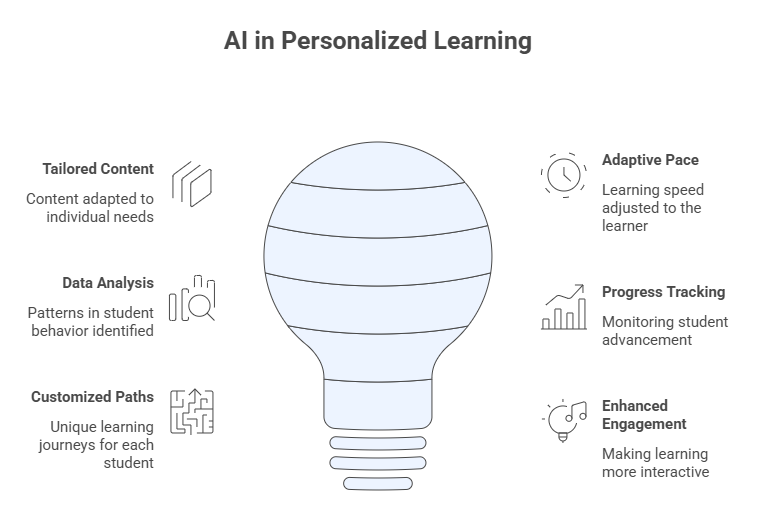
Personalized learning refers to an educational approach where teaching methods, pace, and content are adapted to suit individual learner needs. It ensures that students receive instruction based on their strengths, weaknesses, and learning preferences.
AI enhances this approach by using algorithms and data analysis to customize learning experiences. It can identify patterns in student behavior, track progress, and adjust content accordingly making learning more precise and effective.
In traditional classrooms, teachers often deliver the same content to all students which left some students behind while others may have not felt challenged enough. AI-driven systems address this limitation by offering customized learning paths.
The integration of ai in personalized learning ensures that each student receives the right support at the right time. This results in better understanding, improved performance, and a more engaging learning experience.
How AI in Education Enables Personalized Learning
Adaptive Learning Algorithms
Adaptive learning systems work by continuously mapping a student’s responses against a content model. Based on correctness, speed, and attempt patterns, the system recalibrates difficulty, sequencing, and content type in real time. This ensures that students are neither overwhelmed nor under-challenged, but consistently operating at an appropriate level.
A widely cited study by RAND Corporation on personalized learning initiatives found measurable gains in student performance, particularly in mathematics and reading.
Real-Time Student Data Analysis
AI systems continuously process learning data such as quiz results, time-on-task, and interaction patterns. This allows them to identify gaps immediately and trigger timely interventions, rather than waiting for periodic evaluations.
According to OECD, data-driven systems in education improve decision-making and enable more targeted support for learners.
Intelligent Tutoring Systems
Intelligent tutoring systems guide students step by step, offering hints, feedback, and alternate explanations based on their responses. These systems simulate structured one-on-one support by adapting instruction at each stage of problem-solving.
Research referenced by the National Bureau of Economic Research shows that high-dosage tutoring, including technology-supported models, can significantly improve student learning outcomes.
Link:
Intelligent Tutoring Systems
Intelligent tutoring systems simulate guided instruction by breaking down problems, offering hints, and adapting explanations based on student input. They use decision trees and probabilistic models to determine what kind of support a learner needs at each step.
Research supported by Carnegie Mellon University shows that AI-based tutoring systems can achieve learning gains comparable to one-on-one human tutoring in structured subjects.
Link:
Automated Assessment & Feedback
AI-driven assessment systems evaluate responses instantly using predefined rubrics and pattern recognition. More importantly, they attach contextual feedback, pointing out not just what is wrong, but why, enabling immediate correction and reinforcement.
Predictive Learning Analytics
Predictive analytics models use historical and real-time data to identify risk signals such as declining engagement, repeated errors, or slowed progression. Based on these indicators, the system can recommend interventions before performance drops significantly.
Industry research demonstrates how predictive models can identify at-risk students early and improve retention through proactive academic support.
Benefits of AI in Personalized Learning
- Flexible Learning Pace
Learning adjusts dynamically to performance, so students spend more time where needed and move faster through what they already understand. - Improved Engagement
AI surfaces the right format and difficulty level at the right time, reducing drop-offs and keeping students consistently involved. - Faster Concept Mastery
Instead of revisiting entire topics, students work specifically on gaps, making practice more efficient and outcomes more measurable. - Early Detection of Learning Gaps
Patterns like repeated errors or slowed progress are flagged early, allowing intervention before performance visibly declines. - Enhanced Teacher Productivity
Routine tasks like grading, tracking, and basic feedback are automated, freeing up time for targeted teaching and student interaction.
Real Applications of AI in Personalized Learning Classrooms
AI-driven personalized learning functions as an integrated system rather than a set of isolated tools. At its core are AI-powered Learning Management Systems (LMS), which deliver content while tracking student performance and adjusting lessons based on individual progress.
Building on this, recommendation systems guide learners toward relevant materials based on their current level. In parallel, AI tutors and chatbots provide immediate support, helping students resolve doubts and continue learning beyond the classroom.
Assessment and insights also become more dynamic within this setup. Adaptive testing adjusts question difficulty in real time, while teacher dashboards consolidate performance data, making it easier to identify gaps and respond effectively.
Implementing such systems requires thoughtful integration of technology within existing educational frameworks. This is where players like NAVNEET TOPTECH come in, supporting institutions in building and implementing AI-driven learning solutions that are not only functional but also aligned with real classroom needs. By bridging education and technology, we help create systems that are scalable, effective, and grounded in how learning actually happens.
The Future of AI in Personalized Learning (2026–2030)
Over the next few years, AI in education will move from being an added capability to becoming a core part of how learning is designed and delivered. One of the most significant developments will be the rise of truly individualized learning pathways. In simple terms this means, continuously evolving journeys that adjust based on performance, preferences, and long-term goals, allowing students to navigate education in a way that is both structured and flexible.
The role of educators will also evolve alongside this shift. AI-powered assistants will take on routine responsibilities such as basic query resolution, administrative tasks, and performance tracking, enabling teachers to focus more on instruction, mentorship, and critical thinking development within the classroom.
At the same time, decision-making within education will become more forward-looking. Predictive systems will support academic planning by identifying strengths early and mapping them to potential career directions, while hybrid learning models will become more cohesive, with AI ensuring continuity between digital and in-person experiences.
Together, these changes point toward a learning ecosystem that is more responsive, better connected, and designed to support both students and educators with greater precision.
The Evolving Role of AI in Learning
As learning environments become more diverse and outcomes more closely tied to individual progress, the ability to respond to each student’s needs will define how effective a system truly is.
AI is steadily enabling this shift, not by replacing traditional methods, but by strengthening them with deeper insight, responsiveness, and precision.
What lies ahead is not just wider adoption, but better integration. Systems will become more intuitive, educators more empowered, and learning experiences more aligned with real-world demands. Institutions that invest in this direction today are not just improving outcomes, they are building learning environments that are prepared for what education is becoming.
FAQs
Q1. How does AI enable personalized learning in education?
AI enables personalized learning by analyzing student performance, identifying learning patterns, and adjusting content based on individual needs. It can recommend lessons, modify difficulty levels and provide targeted support, helping students learn at a pace and style that works best for them.
Q2. What is AI in personalized learning?
AI in personalized learning refers to the use of artificial intelligence to create customized learning experiences for students. It uses data, adaptive learning algorithms and intelligent systems to personalize lessons, assessments, and feedback based on each learner’s strengths and progress.
Q3. What are the benefits of AI-driven personalized learning?
AI-driven personalized learning helps students learn at their own pace, improves engagement, identifies learning gaps early and offers faster feedback. It also supports teachers by automating routine tasks like grading and progress tracking, allowing more time for focused teaching.
Q4. How do adaptive learning systems work?
Adaptive learning systems track student responses, time spent on activities, and progress across topics. Based on this data, the system adjusts lesson difficulty, changes content sequence and recommends relevant resources to match the learner’s current understanding.
Q5. Can AI replace teachers in personalized learning?
No, AI is designed to support teachers, not replace them. While AI can automate repetitive tasks and provide insights, teachers continue to play the essential role of mentoring students, building understanding and guiding classroom learning with human judgment and experience.
Q6. What is the future of AI in personalized learning?
The future of AI in personalized learning includes more advanced adaptive learning paths, stronger predictive analytics, AI-powered tutoring support and better integration between classroom and digital learning. From 2026 onward, AI is expected to become a more central part of how education is delivered and managed.