
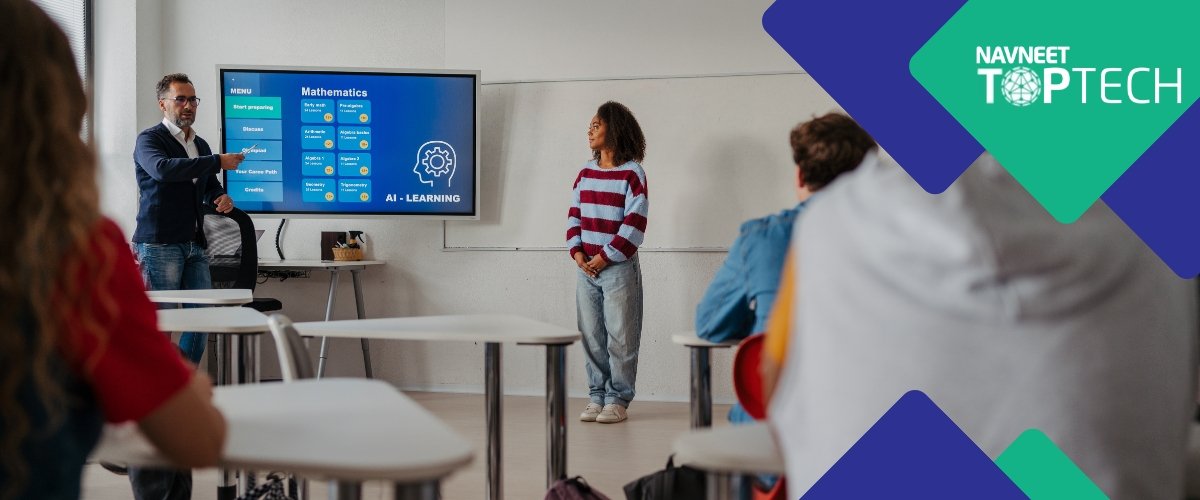
The phrase “smart classroom” gets used so loosely in India that it has nearly lost its meaning. This piece is not about the hardware. It is about outcomes, what the evidence says about whether smart classrooms actually make students learn more, learn better, and stay more engaged, and what separates the programmes that work from the ones that gather dust.
What Is a Smart Classroom?
For the purposes of this article, a smart classroom is a learning environment that integrates:
- Interactive display technology (smart boards, digital panels) replacing or supplementing static blackboards
- Curriculum-aligned digital content – animated explanations, simulations, videos mapped to the specific syllabus
- Assessment tools – formative quizzes and exercises with real-time feedback for teachers
- Student and teacher devices enabling collaborative and personalised work
A projector playing a YouTube video is not a smart classroom. A fully equipped digital learning environment with curriculum-mapped content and teacher analytics is. The difference matters enormously when evaluating outcomes.
Do Smart Classrooms Improve Student Engagement?
Sustained attention is the prerequisite for learning. If a student is not attending, nothing else matters.
A 2022 study by the Central Square Foundation across 200+ government schools in India found that visual and interactive content increased average student attention spans by 34% compared to traditional chalk-and-talk instruction. The effect was strongest in Classes 4–8, where abstract concepts fractions, cell biology, historical causation, benefit most from visual representation.
Do Smart Classrooms Improve Learning Outcomes in Core Subjects?
Mathematics: A longitudinal study across 150 schools in Maharashtra found that students in smart classrooms showed a 28% improvement in conceptual mathematics scores over two academic years, compared to matched schools without smart classroom infrastructure. The key factor was not just the technology but the use of adaptive practice tools that identified and addressed individual concept gaps.
Science: Simulation-based learning virtual chemistry experiments, biological processes at a cellular level, interactive physics modelling has consistently shown strong outcomes in Indian contexts. Students who cannot access a fully equipped science lab can nonetheless develop conceptual understanding through well-designed digital simulations.
Language and Literacy: Smart classroom tools with read-aloud features, vocabulary games, and interactive comprehension exercises have shown particular benefit for first-generation learners. The multi-sensory input (audio + visual + interactive) strengthens retention in ways text alone cannot.
How Do Smart Classrooms Help Teachers, Not Just Students?
This is the finding that most smart classroom marketing glosses over: the biggest beneficiary of smart classroom technology is often not the student directly, it is the teacher.
When teachers have access to ready-made curriculum-aligned content, they reduce preparation time by 30–40%. When they have real-time assessment data showing which students are struggling, they can act immediately. A 2023 NCERT report on technology integration found that teacher satisfaction and perceived teaching effectiveness increased significantly in schools with well-implemented smart classroom programmes and that this teacher confidence directly correlated with improved student outcomes.
Do Smart Classrooms Improve School Attendance?
Smart classrooms that incorporate engaging content have been associated with measurable improvements in school attendance, particularly in rural and semi-urban settings. Students who look forward to class come to class. The implications are profound in a country where dropout rates — particularly for girls in Classes 6–10 — remain a serious challenge.
Smart Classroom Outcomes: Evidence from Maharashtra Schools
Across schools in Maharashtra where NAVNEET TOPTECH’s curriculum-aligned digital content has been deployed alongside teacher training programmes:
70%+ Average class participation rate, up from ~40% within one academic year
35% Reduction in teacher lesson preparation time on average
28% Improvement in conceptual Maths scores across Maharashtra smart classroom schools
34% Increase in student attention spans vs chalk-and-talk instruction (Central Square Foundation, 2022)
Why Do Some Smart Classrooms Fail to Deliver Results?
Thousands of Indian schools have installed projectors, screens, and computers that sit largely unused. Understanding why is crucial before any school commits a budget to this infrastructure.
The Content Must Be Curriculum-Aligned
1. Generic international content however beautifully produced does not serve Indian students well if it is not mapped to the specific syllabus they are studying. Curriculum alignment is non-negotiable, and it is one of the biggest weaknesses in the Indian smart classroom market.
2. Teachers Must Be Trained and Supported
The single most common reason smart classroom investments fail is inadequate teacher training. Technology that teachers do not understand or trust will not be used. Training is not a one-time event, it requires ongoing support and a school culture that values experimentation.
3. The Technology Must Work Reliably
Power cuts, connectivity issues, hardware maintenance gaps these are real operational challenges in Indian school contexts. Schools should ask vendors: What is your offline content capability? What is your maintenance SLA? How many installed schools have sustained active use after 18 months?
4. School Leadership Must Champion It
Smart classroom programmes that thrive have principals who are champions, not spectators. A principal who visits classrooms, asks how the tools are working, and tracks usage data creates the accountability that separates a programme that changes a school from one that fades after the inauguration.
What Should School Leaders Ask Before Investing?
Smart classrooms work when implemented well. Before your school invests, ask four questions
- Is the content mapped to my specific board and syllabus? (CBSE/NCERT or the relevant State Board)
- What teacher training and ongoing support is included, not sold separately?
- What does active usage look like after 18 months in comparable schools?
- How does the technology work when connectivity or power is unreliable?
The right answer to all four is a smart classroom programme worth considering. Anything short of that is a hardware purchase dressed up as an education solution.