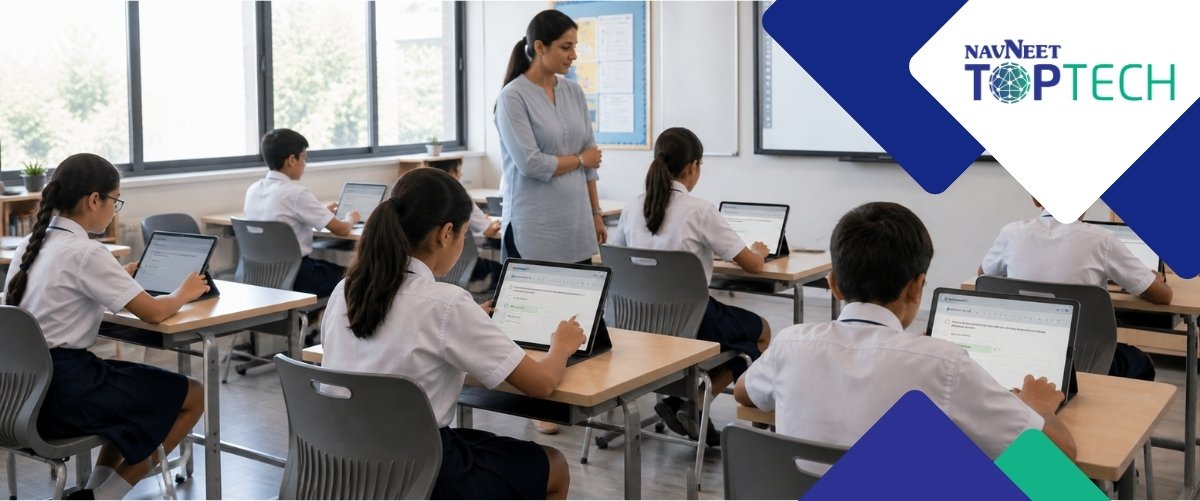
The conversation around education is no longer just about getting students into classrooms, it’s about improving what happens inside them. The World Bank’s World Development Report 2018: Learning to Realize Education’s Promise emphasises that effective teaching practices are central to better learning outcomes, prompting schools to adopt classroom tools that make lessons more engaging, interactive, and student-centred.
As a result, visual content, digital assessments, collaborative activities, and interactive learning have become an integral part of many classrooms today.
At the centre of this shift is the smart board for teaching. More than just a digital display, it helps teachers explain concepts more effectively while encouraging students to participate, explore, and engage with classroom lessons.
In this blog, we’ll explore how interactive smart boards enhance classroom learning, the benefits they offer teachers and students, and the key factors schools should consider when choosing the right solution.
Key Takeaways:
- Interactive smart boards make learning more engaging through active participation.
- Smart boards enhance teaching with visual content, collaboration, and real-time interaction.
- Smart boards support diverse learning styles, making lessons more inclusive and easier to understand.
- Integration with assessment and classroom tools creates a more connected learning environment.
- Interactive smart boards are shaping future-ready classrooms with more effective teaching and learning.
What Is a Smart Board for Teaching and How Does It Work?
A smart board for teaching is an interactive digital display that allows teachers and students to engage with lesson content directly on the screen. Unlike traditional whiteboards, it combines touch-enabled technology with multimedia capabilities, creating a more dynamic learning environment.
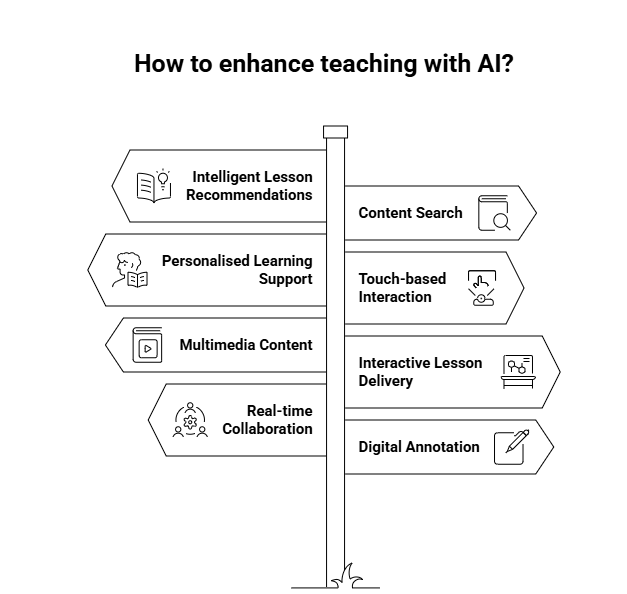
Most modern Interactive Smart Boards support:
AI-powered teaching assistance, including intelligent lesson recommendations, content search, and personalised learning support
- Touch-based interaction
- Multimedia content such as videos, images, and presentations
- Interactive lesson delivery
- Real-time classroom collaboration
- Digital annotation and note-taking
Instead of simply presenting information, teachers can interact with content in real time, making lessons more visual and engaging for students.
Understanding what a smart board does is only the starting point. The real impact becomes visible when it is integrated into everyday classroom teaching.
Key Benefits of Using a Smart Board for Teaching in Modern Classrooms
From improving classroom interactions to supporting better learning outcomes, smart boards offer several advantages for both teachers and students. Some of the key benefits include:
1. Improves Student Engagement and Concept Understanding
Keeping students focused throughout a lesson can sometimes be challenging, especially when concepts are explained using only textbooks or lectures.
Smart boards make lessons more interactive through visual demonstrations, touch-based activities, videos, and classroom discussions that encourage students to participate rather than observe passively.
These interactive experiences help simplify complex concepts. Whether it is a science experiment or a mathematical concept, animations and simulations make abstract ideas easier to understand.
2. Supports Different Learning Styles for Better Retention
While some students understand concepts through diagrams, others benefit from discussions, practical demonstrations, or interactive activities.
Smart boards make it easier to combine these approaches within a single lesson by incorporating visuals, videos, and collaborative exercises.
This multi-sensory learning experience not only makes lessons more inclusive but also improves knowledge retention, as students are more likely to remember concepts they actively see, hear, discuss, and apply
3. Encourages Collaboration and Participation
Smart boards make it easier to facilitate group activities, brainstorming sessions, collaborative problem-solving, and classroom discussions where students can contribute directly on the screen.
These interactive experiences promote active participation while also helping students develop important communication, teamwork, and critical thinking skills.
4. Enables Real-Time Assessment and Continuous Feedback
Smart boards can be integrated with student assessment software to conduct quizzes, polls, and quick classroom assessments in real time.
This allows teachers to monitor student understanding throughout the lesson, identify learning gaps early, and adapt their teaching when needed.
Instead of waiting until the end of a unit, progress can be tracked continuously, enabling more timely support and better learning outcomes.
How Digital Boards for Classrooms Support Effective Teaching
Teaching today often involves balancing curriculum goals, varied learning needs, and limited classroom time. Digital boards for classrooms support this shift by giving teachers the flexibility to move beyond one-way instruction and adopt more dynamic teaching approaches.
Whether facilitating inquiry-based learning, demonstrating real-world applications, encouraging collaborative problem-solving, or incorporating multimedia into lessons, digital boards make it easier to adapt teaching strategies to different topics and classroom needs.
They also support spontaneous discussions, allowing teachers to respond to students’ questions with relevant visuals, examples, or activities as lessons unfold.
Rather than changing what teachers teach, digital boards enhance how they teach by creating classrooms that are more flexible, responsive, and centred around active learning.
The Role of Interactive Smart Boards in Creating Future-Ready Classrooms
As schools continue adopting technology-enabled learning models, classroom tools are expected to support much more than content display.
Today’s Interactive Smart Boards often integrate with educational applications, digital learning resources, assessment platforms, and classroom management systems. This allows schools to create connected learning environments where teaching, assessment, and engagement work together more seamlessly.
They also support hybrid and technology-enabled learning approaches, helping schools remain adaptable as educational needs continue to evolve.
This growing flexibility is one reason many institutions are investing in smart boards for schools as part of their long-term digital learning strategy.
Creating More Meaningful Learning Experiences
Technology is most effective when it supports meaningful learning experiences rather than simply replacing traditional tools. A smart board for teaching helps bring lessons to life through visual content, interactive activities, collaboration, and real-time feedback.
As classrooms continue evolving, tools such as Interactive Smart Boards, student assessment software, and digital boards for classrooms are helping schools create learning environments that are more engaging, responsive, and effective.
The future of classroom learning is likely to be increasingly interactive, and schools that embrace these technologies are better positioned to support the needs of modern learners.
FAQs
Q1. What are the benefits of using a smart board for teaching?
A smart board for teaching can improve student engagement, support different learning styles, encourage collaboration, and make lessons more interactive and easier to understand.
Q2. How do Interactive Smart Boards improve student engagement?
Interactive Smart Boards allow students to participate through touch-based activities, visual content, quizzes, and collaborative classroom exercises, making lessons more engaging.
Q3. Can a smart board for teaching be integrated with student assessment software?
Yes. Many smart boards can work alongside student assessment software to conduct quizzes, track progress, and provide real-time feedback.
Q4. Why are digital boards for classrooms becoming popular in schools?
Digital boards for classrooms support interactive teaching, visual learning, classroom collaboration, and efficient lesson delivery, making them valuable tools for modern education.
Q5. Are Interactive Smart Boards suitable for all grade levels?
Yes. Interactive Smart Boards can be adapted for different age groups and subjects, making them suitable for primary, secondary, and higher education classrooms.