

With increasing administrative responsibilities, rising student numbers, and growing expectations from parents, schools are turning to technology to manage operations more efficiently and enhance learning experiences. Two systems frequently discussed in this context are ERPs and LMS. Both are powerful tools designed to support modern education, yet they serve very different purposes.
Let’s explore what each system does and which one your school might actually need.
What Is a School ERP (School Management Software)?
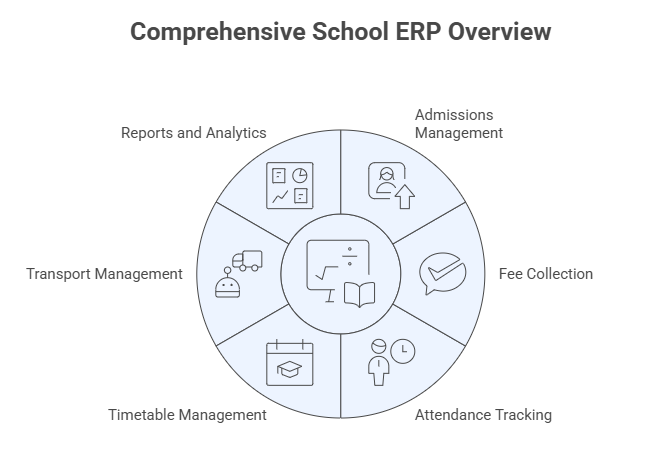
A School ERP (Enterprise Resource Planning system) is designed to manage the administrative and operational processes of a school.
Traditionally, many schools relied on manual records, spreadsheets, or disconnected software tools to handle administrative tasks. This approach often resulted in duplicated work, data errors, and difficulty accessing important information. A school ERP solves these challenges by organising all operational data in one system.
Some of the core functions of a school ERP include:
- Admissions management – managing student applications, registrations, and enrollment processes
- Fee collection and financial management – tracking payments, generating receipts, and maintaining financial records
- Attendance tracking – recording daily attendance of students and staff
- Timetable management – scheduling classes and organising academic calendars
- Transport management – monitoring school transport routes and student allocations
- Reports and analytics – generating reports related to student records, finances, and institutional performance
By centralising these activities, ERP systems reduce paperwork, minimise human errors, and make administrative processes faster and more transparent.
What Is an LMS (Learning Management System)?
A Learning Management System (LMS) is designed specifically for teaching and learning activities.
An LMS is a digital platform where teachers can create, organise, and deliver learning content while students can access lessons, complete assignments, and participate in assessments.
It essentially functions as a virtual classroom environment that supports both in-person and remote learning.
Key functionalities of an LMS include
- Digital lesson delivery – uploading videos, notes, presentations, and reading materials
- Assignments and submissions – allowing students to submit work online
- Online quizzes and tests – conducting assessments digitally
- Teacher feedback and grading – evaluating student performance within the platform
- Progress tracking – monitoring student engagement and academic development
An LMS enhances interaction between teachers and students by making learning resources easily accessible and structured. It also allows educators to organise course material more efficiently while encouraging active participation from students.
| Aspect | ERP | LMS |
| Purpose | Administrative efficiency | Academic delivery and engagement |
| Primary Users | School administration and management | Teachers and students |
| Interaction | Limited student interaction | Active student participation |
| Core Function | Managing records, fees, reports | Delivering content, assessments, feedback |
| Outcome | Efficient school operations | Enhanced learning experience |
Simply put, ERP manages how a school operates, and LMS supports how students learn.
Why Schools Often Use Both
Since ERP and LMS address different aspects of school functioning, many institutions find it beneficial to use both systems together.
A school ERP ensures that administrative processes run smoothly, allowing administrators to focus on strategic decision-making. At the same time, an LMS supports academic continuity and engagement by enabling teachers to deliver structured lessons and track student learning outcomes.
When these two systems are integrated, schools experience several advantages:
- Centralised data management across administrative and academic processes
- Improved coordination between school management and teaching staff
- Better visibility of student performance and attendance
- Reduced duplication of information across multiple systems
- Integration ultimately creates a more cohesive digital environment where operations and learning processes work together efficiently.
Which System Does Your School Really Need?
The decision to implement an ERP, an LMS, or both should be guided by a school’s operational realities and its long-term educational vision.
For smaller institutions or schools working with limited budgets, adopting one system at a time is often the most practical starting point. Many schools begin with an ERP to streamline administrative processes such as student records, fee management, attendance tracking, and reporting. This reduces manual workload and creates a more organised operational framework.
However, institutions that are actively investing in digital learning often benefit from implementing both ERP and LMS systems together. While the ERP manages institutional operations, the LMS enables structured digital learning, content delivery, assessments, and continuous academic engagement.
When evaluating which system to adopt, schools should assess the following factors carefully:
1. Size of the institution and number of students
The larger the student body, the greater the volume of academic and administrative data that must be handled daily. Schools with growing enrolment or multiple sections often need systems capable of managing large datasets and coordinating across departments.
2. Budget and technology infrastructure
Beyond initial costs, schools should consider implementation, training, and long-term maintenance. Existing infrastructure such as reliable internet access, devices for teachers, and basic digital readiness will influence how smoothly a new system can be adopted and integrated into daily workflows.
3. Long-term digital learning goals
Schools that aim to incorporate blended learning, digital assignments, online assessments, or interactive classroom resources will benefit significantly from an LMS. Evaluating future academic goals helps determine whether the institution needs only administrative automation or a broader digital learning ecosystem.
4. Ease of use for teachers, administrators, and students
Technology adoption succeeds only when it is easy to use. Schools should evaluate whether the platform provides simple dashboards, clear workflows, and minimal learning curves so that teachers and administrators can focus on teaching and management rather than struggling with technology.
5. Scalability with growth
Institutions evolve over time by adding more students, new programs, additional campuses, or expanded academic offerings. The chosen system should be flexible enough to accommodate this growth without requiring a complete technological overhaul in the future.
Carefully assessing these factors helps schools make informed decisions that support both operational efficiency and educational quality rather than adopting technology simply because it is trending.
Working with a reliable education technology partner can further simplify this process. NAVNEET TOPTECH supports schools with integrated digital solutions designed specifically for the education ecosystem, helping institutions implement ERP and LMS systems in a way that aligns with their administrative requirements, academic goals, and future growth plans.
Bringing Administration and Learning Together
The discussion around ERP and LMS should not be about choosing one over the other, but about understanding what problem each system solves within a school.
With thoughtful planning and the support of experienced schools can adopt solutions that not only solve immediate challenges but also support sustainable growth, better management, and stronger learning outcomes in the years ahead.
FAQs
Q1. What is the difference between a Learning Management System and School Management Software?
A Learning Management System (LMS) supports teaching and learning through lessons, assignments, assessments, and progress tracking. School Management Software, or a School ERP, manages administrative functions such as admissions, fees, attendance, and timetables.
Q2. ERP vs LMS: Which system should a school choose?
The choice depends on the school’s needs. An ERP helps streamline administration, while an LMS supports digital learning and student engagement. Many schools use both systems to manage operations and academics effectively.
Q3. What is LMS ERP integration?
LMS ERP integration connects learning and administrative systems, allowing data to flow between platforms. This helps schools reduce manual work, improve accuracy, and create a more connected digital environment.
Q4. What are the benefits of integrating ERP and LMS systems in schools?
Integrating ERP and LMS systems improves efficiency, reduces duplicate data entry, enhances communication, and provides better visibility into student information and academic progress.
Q5. Is a School ERP the same as a Learning Management System?
No. A School ERP manages operational and administrative activities, while a Learning Management System focuses on teaching, learning, assessments, and student engagement.
Q6. Why are integrated digital systems becoming important for schools?
Integrated digital systems help schools simplify management, improve collaboration, support digital learning initiatives, and provide a better experience for administrators, teachers, students, and parents.