Education has always evolved with time, but with technology influencing almost every aspect of daily life, schools are rethinking how learning happens inside the classroom. One of the most noticeable changes in modern education is the shift from traditional classrooms to smart classrooms. Beyond technology integration, this transition reflects a deeper change in how students learn and how teachers teach.
Understanding this shift requires a closer look at both traditional and smart classroom models, and why schools are increasingly moving towards the latter.
What Are Traditional Classrooms?
Traditional classrooms represent the conventional method of teaching that has been used for generations. In this model, the teacher is the central figure responsible for delivering knowledge, while students primarily listen, take notes, and memorise information.
This approach is largely teacher-centered, meaning the flow of information is mostly one-directional, from teacher to student. While this method provides structure and discipline, it often limits interaction, creativity, and active participation from students. The learning process is usually structured around textbooks, lectures, and written assignments.
Although traditional classrooms have been effective in building foundational knowledge, they may not fully address the needs of today’s learners, who are more exposed to digital content and interactive media.
What Are Smart Classrooms?
Smart classrooms are modern learning environments that integrate digital technology to enhance teaching and learning experiences. Unlike traditional setups, smart classrooms promote a student-centered approach. These classrooms use tools such as interactive tools and multimedia content to make lessons more engaging and accessible.Instead of passively receiving information, students actively participate in discussions, experiential activities, and digital learning experiences.
This approach makes learning more dynamic and helps students understand concepts more effectively through visual and interactive methods.
Key Reasons Schools Are Making the Shift
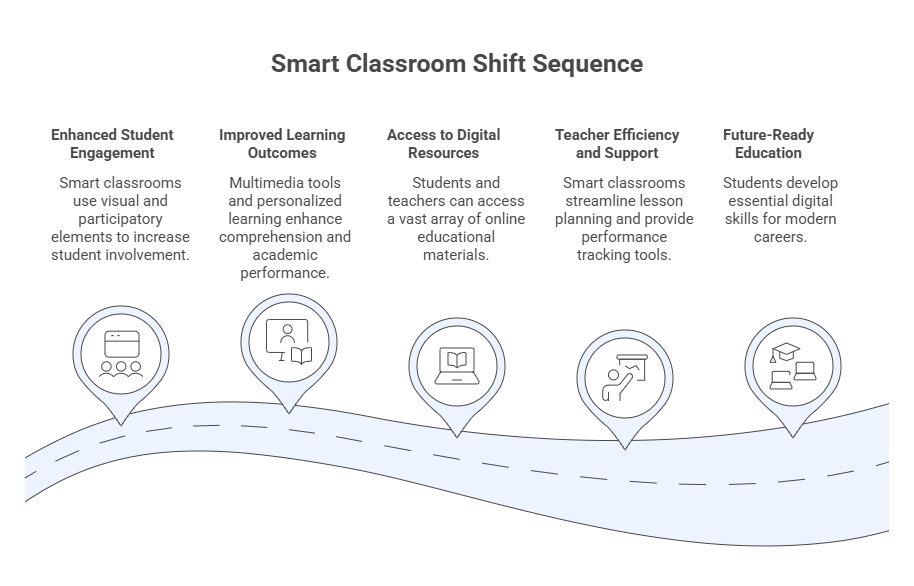
The shift is driven by clear advantages that improve both teaching and learning outcomes.
1. Enhanced Student Engagement
One of the biggest advantages of smart classrooms is increased student engagement. Traditional lectures can sometimes struggle to hold students’ attention, especially in an age where learners have shorter attention spans. Smart classrooms address this by incorporating visual and participatory elements into lessons. Videos, animations, and interactive presentations make concepts easier to understand and more interesting to learn.
As a result, students are more attentive, involved, and willing to participate in classroom activities.
2. Improved Learning Outcomes
Multimedia tools help simplify complex topics by presenting them in a more visual and understandable format. For example, scientific concepts or historical events can be demonstrated through animations or simulations, making them easier to comprehend and remember.
Additionally, smart classrooms support personalized learning, allowing teachers to track and adapt lessons based on individual student needs. This leads to better academic performance and deeper understanding.
3. Access to Digital Resources
Another major reason for the shift is the availability of vast digital resources. In smart classrooms, students and teachers can access e-books and online study materials, educational videos and tutorials that help them gain global knowledge and perspectives in real-time with updates and current information. This access expands learning beyond textbooks and exposes students to a wider range of information.
4. Teacher Efficiency and Support
Smart classrooms make teaching more efficient. Teachers can use pre-designed digital content, presentations, and online tools to plan and deliver lessons more effectively. This reduces the time spent on manual preparation and allows teachers to focus more on student engagement.
Additionally, many smart classroom systems provide analytics and performance tracking, helping teachers identify areas where students need more support and intervene as required.
5. Future-Ready Education
Today’s careers require strong digital skills, adaptability, and the ability to work with technology. Smart classrooms help students develop these competencies from an early stage. By using digital tools regularly, students become more comfortable with technology, improving their digital literacy and readiness for modern careers.
Benefits of Smart Classrooms for Schools
- The adoption of smart classrooms offers several advantages for educational institutions as a whole.
- Better academic performance – Students understand concepts more clearly and perform better in assessments
- Increased student retention – Engaging lessons keep students interested and reduce dropout rates
- Stronger school reputation – Schools that adopt modern teaching methods are often seen as innovative and forward-thinking
- These benefits make smart classrooms a valuable investment for schools aiming to improve both educational outcomes and institutional growth.
Challenges in Transitioning to Smart Classrooms
The transition from traditional classrooms to smart classrooms, while beneficial, presents several practical challenges.
- Initial investment – Setting up digital infrastructure, devices, and software can be costly
- Teacher training – Educators need proper training to effectively use new technologies
- Resistance to change – Some teachers and institutions may be hesitant to move away from familiar teaching methods
However, with proper planning, training, and support, schools can successfully overcome these barriers and fully benefit from modern classroom solutions. This is where NAVNEET TOPTECH can play a pivotal role in easing the transition.
With our expertise in educational resources and digital solutions, NAVNEET TOPTECH can provide schools with integrated smart classroom tools, teacher training programs, and user-friendly platforms that simplify adoption. By offering end-to-end support, from infrastructure guidance to content and capacity building, we help institutions smoothly shift toward a more engaging, technology-driven learning environment.
Redefining Education for a Digital Future
As education continues to evolve, schools that embrace smart classrooms aren’t just keeping up but setting the pace for a more dynamic, inclusive, and future-ready learning ecosystem, one where curiosity drives progress and learning never stands still because the classrooms of today are shaping the possibilities of tomorrow.