

Key Takeaways
- A clear LMS adoption strategy helps schools integrate technology into everyday teaching and learning.
- Common LMS adoption challenges include teacher resistance, limited training, technical limitations, and poor implementation planning.
- Phased implementation, practical training, and continuous feedback can support smoother LMS adoption.
- Measuring teacher engagement, student participation, usage analytics, and stakeholder feedback helps schools improve adoption over time.
As schools continue to integrate technology into teaching and administration, Learning Management Systems (LMS) are increasingly seen as essential infrastructure rather than optional tools. Yet, while many schools adopt an LMS with optimism, the outcomes often vary widely. Some institutions see meaningful improvements in organisation, teaching efficiency, and student engagement, while others struggle. In most cases, the challenge is not the LMS itself but the absence of a clear adoption strategy.
Schools often focus on implementation and onboarding without fully addressing how the LMS will become part of everyday academic practice. As a result, the platform remains underutilised, or worse, becomes an added layer of complexity rather than a support system.
This blog is intended to help educators, and school administrators understand LMS adoption. It explains what LMS ‘adoption’ really means, why a structured strategy matters, the common challenges, and how institutions can approach LMS implementation in a way that is practical, and aligned with their academic goals.
What Is LMS Adoption in Schools?
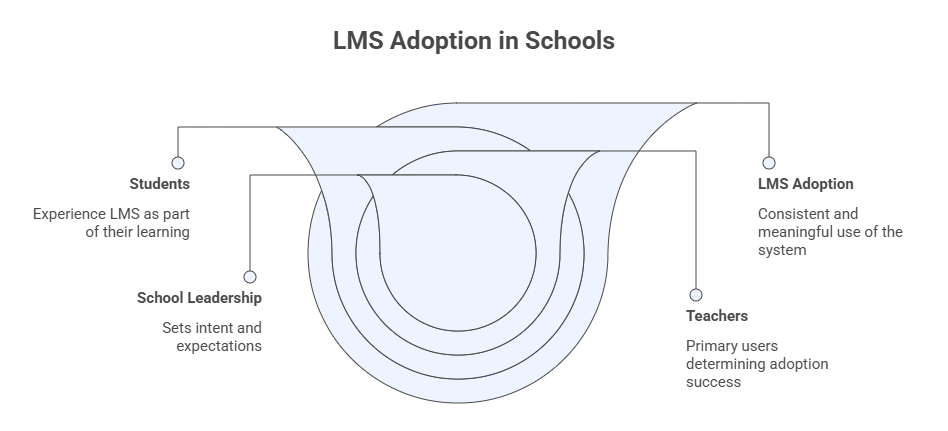
LMS adoption in schools refers to the process through which a learning management system becomes an integral part of daily school functions.This is where the distinction between LMS adoption and LMS implementation becomes important. LMS implementation focuses on the technical setup, configuring modules, onboarding users, and initial rollout. LMS adoption, on the other hand, is behavioural and operational. It reflects how consistently and meaningfully the system is used over time, across classrooms, grades, and stakeholders.
Successful LMS adoption involves multiple stakeholders working in alignment. School leadership plays a key role in setting intent and expectations. Teachers are the primary users whose daily practices determine adoption success. Students experience the LMS as part of their learning journey, while parents engage with it through communication, updates, and academic visibility. Adoption succeeds when all four groups understand the purpose of the LMS and see value in using it.
Why Schools Need a Clear LMS Adoption Strategy
A clear LMS adoption strategy helps schools articulate not just what the LMS will do, but why it exists within their academic ecosystem. When LMS adoption is approached with intention, its impact becomes more visible across stakeholders.
1. Centralised learning management
A defined adoption strategy helps schools bring lesson plans, learning resources, communication, and academic records into one coherent system. Instead of juggling multiple tools and informal processes, teachers and administrators work from a common academic reference point.
This reduces confusion, strengthens coordination across grades and departments, and creates consistency for students and parents.
2. Improved teacher productivity
Teachers are more likely to engage with an LMS when it aligns with how they already teach and manage classrooms. A clear adoption strategy ensures that LMS usage is designed around real instructional needs rather than idealised workflows. As a result, routine tasks become more efficient, allowing teachers to focus their energy on instruction and student support.
3. Better student engagement
When an LMS is clearly positioned as the primary learning space, students know where to access resources, submit work, and receive feedback. This consistency reduces dependence on reminders and parallel systems, enabling students to engage more confidently with their learning.
Risks of Adopting an LMS Without a Strategy
When an LMS is adopted without a clear strategy, schools often encounter a pattern of interconnected issues rather than isolated problems. Usage becomes uneven, with some teachers engaging deeply while others log in sporadically, leading students to perceive the platform as optional rather than essential. At the same time, existing tools and informal processes continue alongside the LMS, creating fragmented workflows, duplicated effort, and confusion across teachers, students, and parents.
For many schools, the decision to adopt an LMS comes when the leadership recognises the need for better organisation, digital continuity, and visibility. However, without a clear adoption strategy, this intent often struggles to translate into day-to-day practice. Without defined goals or benchmarks, it gets difficult for school leadership to assess impact or direction.
Common Challenges in LMS Adoption for Schools

The challenges schools face during LMS adoption often stem from lived realities in classrooms, staff rooms, and administrative offices. Understanding these challenges clearly allows schools to respond with empathy and planning.
1. Resistance to change among teachers
Resistance is often rooted in uncertainty rather than unwillingness. Many teachers associate new technology with disruption to familiar teaching methods or fear that they will be expected to adapt quickly without adequate support. There is also a common perception that LMS usage may increase workload by adding documentation, uploads, or parallel processes. When these concerns are not acknowledged early, hesitation can solidify into disengagement.
2. Lack of digital skills and training
Not all educators have the same level of digital confidence. Limited prior exposure to LMS platforms can make even simple features feel overwhelming. Teachers need training that is practical, paced, and directly connected to classroom scenarios, along with ongoing support as they apply the system in real time.
3. Infrastructure and technical limitations
Many schools operate within constraints related to internet reliability and device availability that directly affect how consistently an LMS can be used across classrooms and grades. Successful LMS adoption accounts for these realities by offering flexibility, offline options where possible, and usage models that adapt to varying levels of access rather than enforcing uniform expectations.
4. Poor LMS implementation planning
Without clear goals or a phased approach, LMS adoption often loses momentum after initial rollout. Inadequate onboarding leaves users unsure of expectations, while the absence of defined objectives makes it difficult to measure progress. When schools do not articulate what success looks like or how the LMS fits into existing academic processes, usage becomes inconsistent and enthusiasm fades.
Recognising these challenges highlights the need for a structured, practical LMS adoption strategy that supports schools through change while accounting classroom realities.
A Step-by-Step LMS Adoption Strategy for Schools
A sustainable LMS adoption strategy is built gradually, with each step reinforcing the next. Rather than attempting a full-scale rollout all at once, schools benefit from a structured approach that aligns academic intent, operational realities, and stakeholder readiness.
1. Assess school needs and learning goals
Effective adoption begins with clarity around academic priorities and operational realities. Schools must evaluate curriculum requirements, classroom practices, administrative workflows, and communication gaps before introducing an LMS. When schools define what success should look like early, it becomes easier to measure progress meaningfully later.
2. Choose the right LMS platform
The platform itself has a direct impact on adoption outcomes. A school LMS must be easy for teachers to use, aligned with curriculum structures, and capable of scaling across grades and departments without increasing complexity. Platforms that require extensive workarounds or ongoing technical intervention often slow adoption instead of supporting it.
Purpose-built solutions like NAVNEET TOPTECH’s TopSchool are designed with school ecosystems in mind. TopSchool aligns closely with classroom workflows, curriculum planning, assessments, and institutional coordination. Its intuitive interface lowers the learning curve for teachers, while its scalable design allows schools to expand usage gradually, without disruption.
Schools looking for LMS solutions for CBSE schools should consider curriculum alignment, ease of use, assessment capabilities, and scalability. When comparing the best LMS providers for schools in India, it is equally important to evaluate how well the platform fits everyday teaching and academic workflows.
3. Plan a phased LMS implementation
Phased implementation allows adoption to grow steadily. Piloting the LMS with select grades or subjects gives schools space to test workflows, gather feedback, and refine processes before scaling. This approach reduces resistance, builds internal confidence, and supports the principle of starting small and expanding based on readiness rather than timelines.
4. Invest in teacher training and capacity building
Ongoing technical support, peer learning, and internal champions play a crucial role in sustaining momentum. Teachers need hands-on, classroom-relevant guidance that evolves as their usage deepens. When teachers know that help is available and feedback is valued, confidence grows and LMS usage becomes more consistent and integrated into daily teaching.
5. Orient students and parents
Clear communication with students and parents ensures that LMS usage is understood and reinforced beyond the classroom. Setting expectations, defining usage guidelines, and highlighting benefits help position the LMS as a shared academic space rather than an optional tool. This alignment strengthens engagement and improves overall adoption outcomes.
6. Gather feedback and refine continuously
LMS adoption improves when schools pay attention to how the platform is actually used. Monitoring engagement patterns, collecting feedback from teachers and students, and making iterative improvements allows schools to respond thoughtfully rather than enforce compliance.
Measuring the Success of LMS Adoption
Measuring LMS adoption is essential to understand whether the system is supporting teaching, learning, and academic coordination in a meaningful, sustained way.
1. Teacher engagement levels
Consistent, purposeful use of the LMS by teachers is a strong indicator of adoption maturity. Engagement should be evaluated through how the platform supports lesson planning, assessments, and classroom communication, rather than through surface-level metrics such as login frequency. When teachers rely on the LMS as part of their routine, adoption has moved beyond mandate.
2. Student learning continuity and outcomes
For students, adoption success is reflected in clarity and consistency. Reliable access to learning materials, structured assignments, and timely feedback indicates that the LMS is supporting learning flow rather than fragmenting it. Improvements in participation and continuity are often more telling than short-term academic shifts.
3. LMS usage analytics and academic visibility
Usage analytics offer leadership visibility into how adoption is progressing across grades and stakeholders. Clear dashboards that track engagement patterns, content usage, and assessment activity allow schools to identify gaps and guide improvement.
Platforms like NAVNEET TOPTECH’s TopSchool offer integrated dashboards that give schools clear visibility into how the LMS is being used across grades and stakeholders. This data supports informed decision-making, allowing schools to identify areas that need support, refinement, or scaling, without resorting to enforcement-driven measures.
4. Feedback from stakeholders
Quantitative data gains depth when paired with human insight. Regular feedback from teachers, students, and parents helps schools understand usability, perceived value, and areas of friction that analytics alone may not reveal. Structured feedback loops reinforce trust and signal that LMS adoption is a shared process rather than a top-down mandate. Over time, this dialogue strengthens alignment and improves adoption quality.
Moving Toward Sustainable LMS Adoption
When schools align strategy with real academic practice and measure adoption thoughtfully, the LMS becomes a stable foundation for coordinated teaching and learning. With the right planning and a platform designed for school realities, adoption evolves from implementation into long-term institutional capability.
With thoughtful planning and the right partner, LMS adoption becomes a foundation for stronger, more connected learning experiences rather than an added layer of complexity.
FAQs
Q1. What are the common LMS adoption challenges in schools?
Common LMS adoption challenges include teacher resistance, limited digital skills, inadequate training, infrastructure limitations, and poor implementation planning.
Q2. How can schools overcome LMS adoption challenges?
Schools can address LMS adoption challenges through phased implementation, practical teacher training, clear usage guidelines, stakeholder orientation, and continuous feedback.
Q3. How can schools improve LMS adoption among teachers?
Schools can improve adoption by providing hands-on training, setting clear expectations, offering ongoing technical support, and involving teachers in the adoption process.
Q4. How can schools measure LMS adoption?
Schools can measure LMS adoption through teacher engagement, student participation, content and assessment usage, LMS analytics, and feedback from teachers, students, and parents.