
As schools across India adopt the principles of NEP 2020 and NCF 2023, the role of assessment is evolving. Assessment is no longer viewed only as a tool to evaluate learning at the end of instruction. It is now expected to support the learning process itself, shaping teaching decisions, strengthening student understanding, and enabling reflective learning.
In this context, distinguishing between Assessment for Learning (AfL) and Assessment of Learning (AoL) is essential. Although often discussed together, they serve distinct purposes in the teaching and learning cycle. Applying each appropriately ensures both meaningful progress and accountability.
What Is Assessment of Learning (AoL)?
Assessment of Learning refers to summative assessment, typically conducted after instruction. Its primary purpose is to:
- Measure academic achievement
- Assign grades or marks
- Report progress to students, parents, and school leadership
Common examples include:
- Unit tests
- End-of-term exams
- Final project evaluations
- Standardized assessments
AoL provides documentation of learning, but it does not inform learning while it is still taking place
What Is Assessment for Learning (AfL)?
Assessment for Learning refers to formative assessment, which takes place during the learning process. Its purpose is to:
- Identify learning gaps in real time
- Provide timely, constructive feedback
- Adjust teaching strategies based on student needs
- Help students reflect on and understand their own progress
AfL makes assessment a supportive instructional tool rather than a final judgment.
Why This Distinction Matters in NEP 2020-Aligned Classrooms
Modern classrooms emphasize:
- Conceptual understanding over memorization
- Application of knowledge
- Critical thinking and reasoning
- Student agency in learning
These expectations require continuous feedback, not just end-of-term evaluation.
Assessment for Learning enables teachers to respond responsively while learning is still underway, helping students strengthen understanding before misconceptions take root.
AfL and AoL: Key Differences
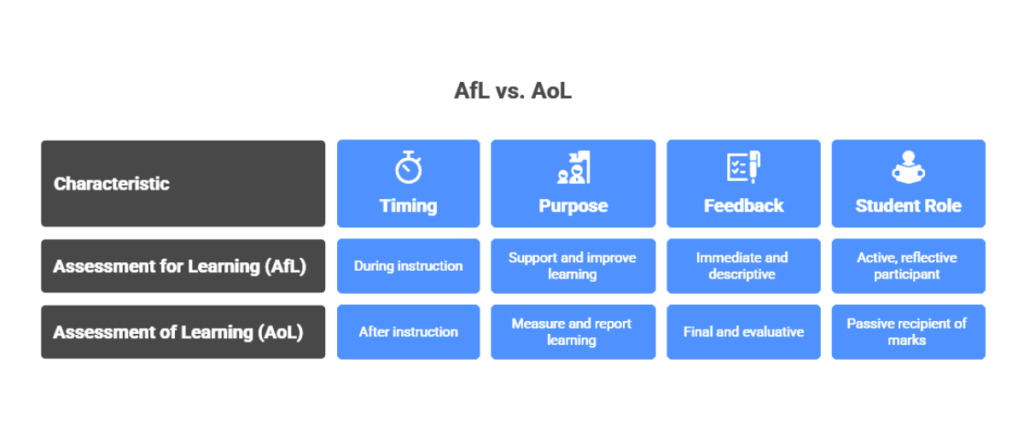
Both are necessary. But AoL alone is insufficient in classrooms aiming for competency-based learning.
Practical AfL Strategies for Daily Classroom Use
These approaches can be integrated without adding additional workload:
| Strategy | Application | Impact |
| Clarify Learning Objectives | Begin each lesson with what students are expected to understand | Builds focus and direction |
| Define Success Criteria | Describe what strong work looks like | Enables self-regulation and correction |
| Exit Reflections | Invite students to summarize clarity and difficulty points | Informs next-day planning |
| Peer Review with Simple Rubrics | Provide structured peer feedback tools | Builds metacognition and responsibility |
The emphasis is on transparency, dialogue, and reflection.
Where Professional Development Supports Implementation
While teachers may understand AfL conceptually, successfully integrating it requires:
- Skill in questioning and feedback
- Classroom organisation strategies
- Practical examples and templates
- Reflective practice support
This transition benefits from structured, ongoing professional learning—not one-time exposure.
How NITYA Supports Schools in Strengthening Assessment Practices
NITYA’s Assessment Strategies for Competency-Based Classrooms training is designed to help educators:
- Apply formative assessment strategies consistently
- Use observation notes, rubrics, and feedback scaffolds
- Align assessment practices with NEP 2020 / NCF 2023
- Build reflective, student-centered assessment routines
The approach is practice-based, ensuring teachers gain both clarity and confidence.