

The CBSE Board Exams 2026 represent a significant stage in the evolving assessment framework of the Central Board of Secondary Education. Over the past few years, the board has been gradually recalibrating how student performance is measured. The 2026 cycle reflects this shift more clearly, placing greater emphasis on applied understanding and competency development.
CBSE Board Exams 2026 will continue the shift toward competency-based assessment, with a greater focus on case-based questions, analytical MCQs, application-oriented learning, and digital evaluation processes. Students in Classes 10 and 12 can expect reduced emphasis on rote learning, stronger integration of conceptual understanding, and continued alignment with the National Education Policy (NEP 2020).
This guide provides a comprehensive overview of the changes implemented for 2026. It examines the updated examination pattern, expected timelines, digital evaluation processes, and the broader implications of these reforms. The objective is to offer clarity through structured explanation, enabling students, educators, and parents to understand not only what has changed, but how these changes influence preparation and performance.
CBSE Board Exam Pattern 2026 Changes and New Rules
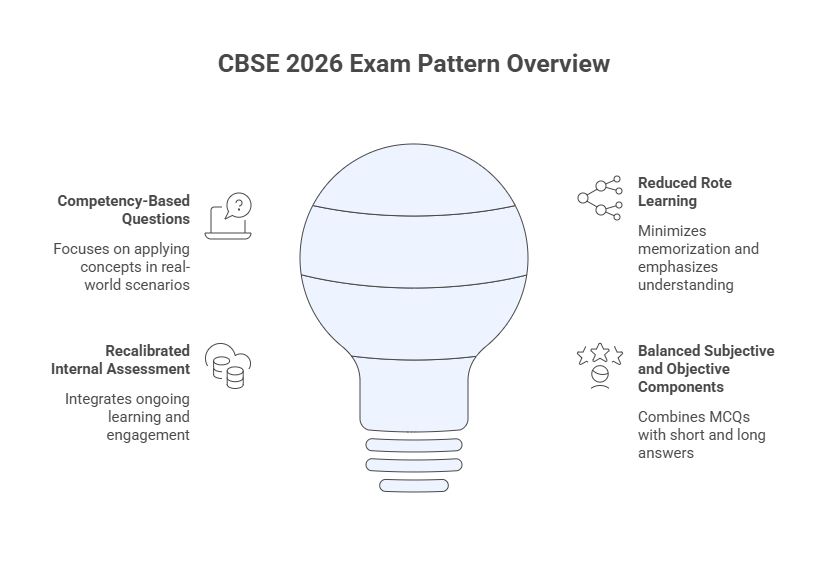
The CBSE 2026 exam pattern update reflects a deliberate alignment with the principles outlined in the National Education Policy. The reform is structural in nature, redefining the way knowledge is assessed across subjects.
1. Shift Toward Competency-Based Questions
Earlier, many board papers rewarded students who could accurately reproduce definitions, derivations, or textbook paragraphs. While conceptual understanding was always valuable, recall-heavy responses often secured marks.
Under the updated structure, a larger portion of the paper is designed to assess a student’s ability to apply concepts in varied contexts rather than reproduce memorised content. The revised pattern includes:
- Case-based questions requiring interpretation of real-life situations
- Analytical multiple-choice questions that test reasoning
- Source-based and data-driven prompts
- Application-oriented problem solving
For instance,instead of asking for a direct definition of a scientific law, a question may present a real-life scenario and require students to identify which principle applies and explain why. In social sciences, case-based passages may ask students to interpret policy outcomes or connect historical developments to present contexts. This format evaluates comprehension, logical structuring, and conceptual transfer.
2. Reduced Emphasis on Rote Learning
The revised framework reduces reliance on direct recall-based questioning. Direct “write the definition” or “state the formula” formats are gradually giving way to “explain with reasoning” or “analyse the following situation” prompts.
While foundational knowledge remains essential, students are increasingly required to demonstrate:
- Conceptual clarity
- Analytical reasoning
- Ability to synthesise information
- Structured explanation
This shift ensures that assessment reflects genuine understanding rather than memorisation patterns.
3. Recalibrated Internal Assessment Structure
Internal assessment continues to carry weight, but its purpose is increasingly aligned with ongoing learning rather than a single-term evaluation. Project work, practical submissions, and periodic assessments are intended to capture consistency, research ability, and engagement over time, making their function more integrative within the academic year.
The emphasis includes:
- Subject enrichment activities
- Practical and laboratory work
- Research-oriented projects
- Periodic academic evaluations
This aligns with the broader reform goal of evaluating learning as a process, not just a final performance snapshot. Schools are expected to maintain structured records, ensuring that internal marks reflect actual academic engagement. This continuous assessment model supports sustained engagement and reduces excessive dependence on final examinations alone.
4. Balanced Subjective and Objective Components
The updated attempts to balance objective formats such as MCQs with short and long answer questions that test articulation, reasoning, and structured writing.
Since the 2026 exam pattern maintains equilibrium between objective and descriptive evaluation formats. Students can expect a combination of:
- Multiple-choice questions for conceptual precision
- Short-answer questions for focused explanation
- Long-answer questions assessing depth and coherence
- Integrated case-study sections
This balanced approach ensures comprehensive evaluation of accuracy, reasoning, and articulation.The intention is to evaluate both precision and depth within the same examination.
CBSE Exam Date 2026: What to Expect
The CBSE exam date 2026 is expected to follow the established February to April examination cycle, subject to official notification.
1. Expected Examination Timeline
Historically, CBSE board examinations commence in mid to late February and conclude by early April. Based on recent cycles, a similar timeframe is anticipated for 2026.
Students are advised to refer to the official website of the Central Board of Secondary Education for confirmed date sheets, subject schedules, and examination guidelines. Official notifications provide credible and updated information regarding any revisions.
2. Structural Impact on Scheduling
If multiple exam windows or attempt options are introduced, spacing between subjects could become more strategically distributed with streamlined grouping. This would allow students to better manage preparation time between major subjects, reducing the compression often seen in earlier cycles.
With the introduction of competency-based evaluation and potential flexibility in exam attempts, the scheduling framework may incorporate refinements in administrative coordination for smoother execution. These measures aim to enhance examination management without disrupting the traditional academic calendar.
3. Tentative Result Declaration Timeline
In recent years, results have typically been declared between May and June. With expanded digital evaluation systems in place, result processing is expected to remain efficient.
Students should monitor official CBSE announcements for precise result dates, re-evaluation processes, and supplementary examination updates.
4. Digital Evaluation and Transparency Measures
One of the less visible but structurally significant reforms in CBSE Board Exams 2026 is the expansion of digital evaluation practices.
5. On-Screen Evaluation System
Answer sheets are scanned and evaluated digitally through centralized systems. This reduces the physical transfer of scripts and enables standardised marking guidelines to be applied more consistently. Evaluators can access model answers and moderation instructions in real time, ensuring greater uniformity in scoring, across evaluation centres.
6. Accelerated Result Processing
Digital compilation allows for quicker aggregation of marks once evaluation is complete. Since answer sheets are already digitised, administrative steps between checking and result declaration are reduced. This streamlining supports timely announcements reducing logistical delays associated with physical script handling.
7. Reduced Scope for Human Error
Layered verification systems and moderated review processes reduce discrepancies that may arise from manual handling. While evaluation still involves human judgment, the digital framework creates a traceable structure that improves accountability and clarity.
8. What These Changes Mean for Students
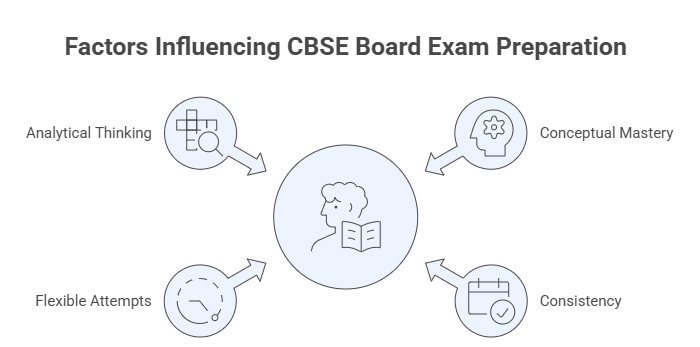
The reforms in CBSE Board Exams 2026 reshape preparation priorities rather than intensifying difficulty.
First, students must cultivate conceptual mastery. Regular engagement with NCERT textbooks, coupled with practice of application-oriented questions, becomes central to effective preparation. Resources such as LEARN SMART CBSE PRACTICE PAPERS MARATHI CLASS 10 – Navneet Education Limited provide structured practice aligned with the revised examination pattern, helping students familiarise themselves with updated question formats
Second, consistency across the academic year gains importance. Internal assessments, practical submissions, and structured projects contribute to cumulative performance.
Third, if flexible attempt structures are fully operationalised, students may experience reduced single-exam pressure, allowing for performance refinement within the same academic cycle.
In essence, preparation must align with understanding, structured practice, and analytical thinking. Finally, consistency matters, maintaining steady academic engagement throughout the year is more effective than last-minute intensive revision cycles.
Final Thoughts
The evolution of CBSE Board Exams 2026 signals a broader transformation in school assessment philosophy. The focus is progressively shifting toward evaluating understanding, reasoning, and academic depth.
For students, this transition underscores the importance of disciplined study, conceptual clarity, and alignment with official guidelines. With the right academic support from NAVNEET TOPTECH, and when preparation reflects the intent of the examination framework, academic performance becomes both structured and sustainable.
FAQs on CBSE Board Exams 2026
Q1. What are the major changes in CBSE Board Exams 2026?
CBSE Board Exams 2026 place greater emphasis on competency-based learning and application-oriented questions. Students can expect more case-based questions, analytical MCQs, and questions that test conceptual understanding rather than rote memorization.
Q2. What is the CBSE Board Exam Pattern 2026?
The CBSE Board Exam Pattern 2026 includes a balanced mix of competency-based questions, objective questions, short-answer questions, and long-answer questions. The pattern is designed to assess critical thinking, problem-solving, and practical application of concepts.
Q3. Are there any new CBSE rules for Class 10 and Class 12 in 2026?
Yes. CBSE continues to align its assessment system with the goals of the National Education Policy (NEP) 2020. The focus is on conceptual learning, competency-based assessment, internal evaluations, and reduced dependence on rote learning.
Q4. When are the results likely to be declared?
Based on recent trends, results are typically announced between May and June. Exact dates will be confirmed by CBSE.
Q5. How should students prepare under the new pattern?
Students should prioritise conceptual clarity, solve case-based questions, practice analytical MCQs, and revise NCERT textbooks thoroughly. Regular exposure to updated practice papers is essential.
Q6. What are the CBSE evaluation guidelines for 2026?
CBSE uses a structured evaluation process that includes digital answer-sheet checking, standardized marking guidelines, and moderation measures to ensure fair and consistent assessment across evaluation centers.
Q7. Will CBSE Board Exams be conducted twice a year in 2026?
CBSE has discussed greater examination flexibility in line with NEP 2020 recommendations. Students should refer to official CBSE announcements for the latest updates regarding multiple exam opportunities.
Q8. What is the passing criteria for CBSE Class 10 and Class 12 in 2026?
Students must meet the minimum passing requirements prescribed by CBSE in both theory and practical components, wherever applicable. The exact criteria vary by subject and should be verified through official CBSE guidelines.