

Across schools today, one reality is becoming increasingly clear: the quality of student learning is determined less by the curriculum in place and more by the consistency with which teaching practices are carried out across classrooms. The same textbook, the same lesson plan, and even the same assessments can lead to very different learning experiences when instructional practice varies teacher to teacher.
This is where the concept of a consistent teaching culture becomes central to school improvement. When schools rely on individual teacher style or instinct, they end up with pockets of excellence, a few high-performing classrooms and many that function very differently. Students’ learning experience becomes unpredictable, and school leaders spend more time solving local classroom issues rather than building system-wide stability.
A strong school is not defined by its best teacher.
It is defined by how consistently good every classroom can be.
The Need for Consistency in Instruction
School leaders frequently observe discrepancies between lesson plans and the actual learning experience in classrooms. Two teachers can deliver the same content, but one classroom will feel purposeful, interactive, and clear, while another feels passive or disconnected.
This variation is not a reflection of teacher commitment. It is a reflection of whether the school has a shared instructional approach. Without one, teachers work in isolation. With one, teachers work in alignment.
Consistency does not mean identical teaching. It means shared expectations and shared practices.
What a Consistent Teaching Culture Looks Like
In schools with strong teaching culture:
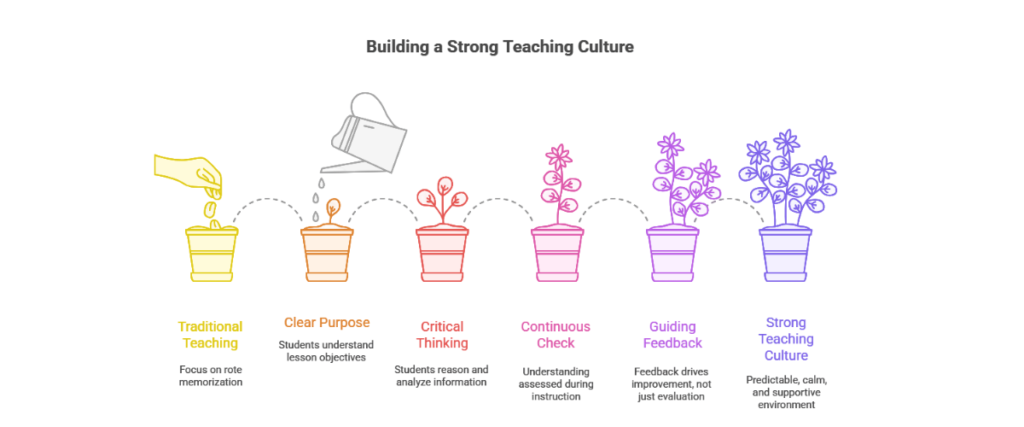
When these elements appear across classrooms, students learn with confidence. They do not have to adapt to vastly different teaching styles each period. They understand what learning looks and feels like.
This stability reduces behavioural issues, increases engagement, and improves student ownership of learning.
The Role of School Leadership
A consistent teaching culture is not created through monitoring, inspection, or reminders.
It is created through:
- Clarity about what quality teaching looks like in your school
- Professional learning that models real classroom practice
- Coaching that supports refinement over time
- Shared language and reflection across teaching teams
Leaders shape culture not by demanding consistency, but by building the conditions that make consistency possible.
When teachers feel supported, guided, and aligned, they teach with confidence.
When teachers teach with confidence, students learn with depth.
This is how schools shift from relying on individual excellence to building cultural excellence.
Why This Matters Now- NEP 2020 Context
The expectations of NEP 2020 and NCF 2023 require:
- Competency-based learning
- Higher-order reasoning
- Collaborative and inquiry-led classrooms
- Student agency and reflection
These learning outcomes cannot be reached if teaching quality varies widely. Consistent instructional practice is not just a school improvement goal,
It is a national academic alignment requirement.
The path to instructional consistency is not about adding more to teachers’ workload. It is about clarifying, simplifying, and aligning what matters most in teaching. This shift is steady, deliberate, and deeply impactful.
If your school is ready to build a coherent teaching culture where learning quality is strong across classrooms, not just in some, we would be glad to support you.
Begin with a leadership conversation:
🌐 www.nityatraining.com
✉️ info@nityatraining.com
Not a presentation. Not a generic workshop. A conversation about your school’s current teaching landscape and your direction for 2026.