

The PARAKH Assessment Framework is India’s national competency-based assessment framework developed under the National Education Policy (NEP) 2020. It evaluates students’ conceptual understanding, application of knowledge, and learning outcomes instead of focusing only on examination scores.
Key Takeaways
- The PARAKH full form is Performance Assessment, Review, and Analysis of Knowledge for Holistic Development.
- The framework focuses on competency-based assessment, including conceptual understanding, application, reasoning, and learning outcomes.
- PARAKH assesses learning progression at key stages, particularly Classes 3, 6, and 9.
- It helps identify learning gaps and provides insights that can support teaching and curriculum improvement.
- PARAKH aligns assessment practices with the broader NEP 2020 vision of holistic, continuous, and learner-centric education.
For decades, assessment in Indian classrooms has largely been about completion. Finish the syllabus, prepare for the exam and score well enough to move ahead. What often went unnoticed was a quieter question beneath it all: how much of this learning actually stayed with the student?
The National Education Policy 2020 sought to correct this imbalance. It marked a shift from memorisation to understanding, from marks to mastery. Assessment, within this vision, was no longer meant to be a final checkpoint, but a continuous lens into how students learn, where they struggle, and how teaching can respond more meaningfully.
This shift required a rethink of assessment itself. The PARAKH Assessment Framework emerges from this need. Introduced under the vision of parakh nep 2020, PARAKH aims to realign how learning outcomes are evaluated at a system level. This blog explains what the PARAKH Assessment Framework 2025 is, what it is designed to measure, what it reveals about learning progression across grades, and why these insights matter for schools, teachers, policymakers, parents, and students shaping India’s classrooms.
What is the PARAKH Assessment Framework 2025?
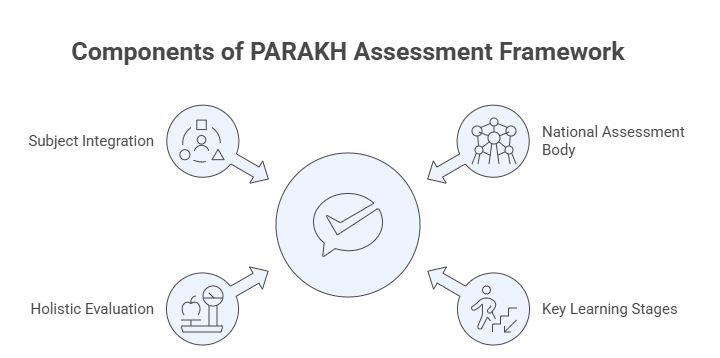
It functions as a national assessment body with a clear purpose: to bring depth, consistency, and meaning to large-scale student assessments in India. The PARAKH assessment framework is designed to generate system-level insights. It focuses on key learning stages, particularly Classes 3, 6, and 9, which represent important transition points in a student’s academic journey. These stages reflect shifts from learning to read to reading to learn, from foundational numeracy to abstract reasoning, and from guided learning to subject specialisation
The framework broadly covers subjects such as language, mathematics, and science, not as isolated disciplines, but as indicators of how students comprehend concepts, apply knowledge, and retain learning over time. At its core, PARAKH emphasises holistic and competency-based evaluation, aligning assessment with the broader goals of NEP 2020.
What PARAKH Reveals About Learning Progression
- Learning across key stages
Assessments at Classes 3, 6, and 9 offer a longitudinal view of how learning evolves. Early-stage gaps, especially in reading comprehension and basic numeracy, often persist if not addressed in time. By the middle grades, these gaps begin to affect students’ ability to engage with abstract concepts, follow multi-step problems, and apply knowledge independently.
- Subject-level learning signals
Across language, mathematics, and science, certain patterns emerge consistently. In language, students may decode text but struggle with deeper comprehension. In mathematics, procedural familiarity does not always translate into conceptual clarity. In science, recalling facts is often easier than applying principles to unfamiliar situations. These observations reinforce a critical insight: surface-level performance can mask deeper learning challenges unless assessment probes beyond correct answers.
- The compounding effect of early gaps
As students move into higher grades, unresolved foundational gaps make academic progression more demanding. This validates NEP 2020’s strong emphasis on foundational literacy and numeracy as the bedrock of long-term learning success.
What PARAKH Is Designed to Measure
The PARAKH framework is designed to look beyond whether an answer is correct, and instead understand how a student arrived there.
1. Foundational and conceptual understanding
One of the primary objectives of PARAKH 2025 is to assess whether students have truly grasped foundational concepts. For example, in early grades, a student may be able to read a passage aloud fluently, yet struggle to explain its meaning or draw inferences from it. PARAKH assessments are structured to surface this difference between surface-level ability and conceptual clarity.
Early learning outcomes, especially in language and numeracy, shape how confidently students engage with complex ideas in later years. When these foundations are weak, gaps tend to widen with each grade.
2. Thinking beyond recall
PARAKH moves away from assessments that reward rote memorisation. Instead, it focuses on comprehension, application, and reasoning. Questions are structured to evaluate how students interpret information, solve problems, and connect ideas, reflecting the competencies outlined in NEP 2020.
In subjects like mathematics or science, students often learn procedures by repetition. PARAKH seeks to understand whether those procedures translate into reasoning. Can a student apply a familiar concept to a new situation? Can they explain why a method works, not just execute it? PARAKH emphasises holistic and competency-based evaluation rather than rank-oriented testing.
3. Evidence for meaningful reform
At a system level, PARAKH provides evidence that supports curriculum refinement, teacher development, and instructional planning. The intent is not to label students or schools, but to help education systems respond more precisely to real learning needs.
What PARAKH Means for Key Stakeholders
- For Schools and Teachers
For schools, PARAKH shifts assessment from a reporting exercise to a reflective one. Instead of relying solely on end-term results, educators gain insights into where conceptual breakdowns occur and which competencies need reinforcement.
For teachers, this supports a move towards competency-based instruction. Assessment data can inform classroom strategies, encourage differentiated teaching, and strengthen formative assessment practices that respond to how students are actually learning, not just how much content has been covered.
- For Students
For students, assessment becomes less about judgement and more about growth. When learning is evaluated continuously and contextually, it reduces exam anxiety and supports confidence. Students are encouraged to understand concepts deeply rather than memorise answers for short-term performance.
- For Parents
For parents, PARAKH offers a clearer picture of their child’s learning journey. Instead of interpreting progress only through marks, they gain insight into strengths, areas of difficulty, and conceptual development, enabling more informed support at home.
- For Policymakers and Institutions
At a system level, PARAKH enables more evidence-led decision-making. Learning trends across grades and subjects help policymakers identify where curriculum alignment, teacher training, or academic support structures need strengthening. This reduces reliance on assumptions and allows reforms to be grounded in classroom realities.
Challenges Highlighted by PARAKH
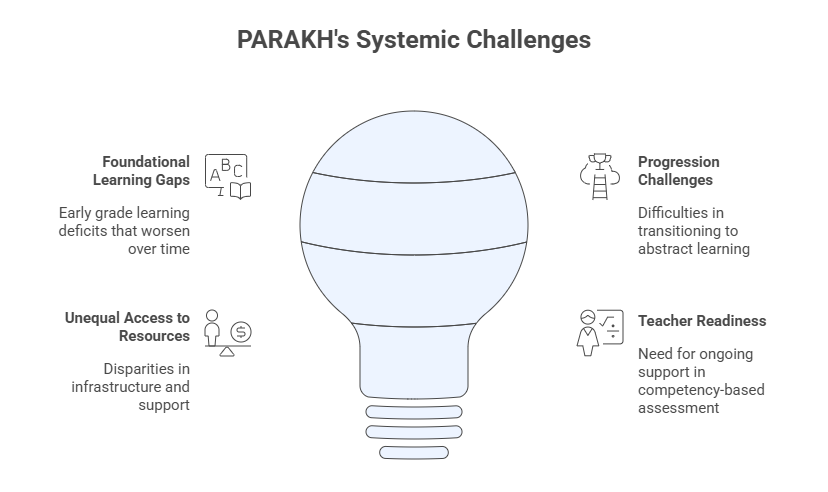
The insights generated through PARAKH also bring certain systemic challenges into sharper focus:
- Foundational learning gaps, particularly in early grades, that become more pronounced in higher classes
- Progression challenges as students transition from basic skills to abstract and application-based learning
- Unequal access to resources, including infrastructure and academic support across regions
- Teacher readiness, especially the need for sustained support in adopting competency-based assessment practices
These challenges reflect the scale and complexity of assessment reform, rather than shortcomings of the framework itself.
The Way Forward Under NEP 2020
PARAKH aligns closely with NEP 2020’s long-term vision of continuous, formative, and learner-centric assessment. When used effectively, it enables schools to move from episodic testing to ongoing learning support. Its real value, however, lies in what happens after insights are generated. Assessment findings need to be interpreted, contextualised, and acted upon consistently within classrooms for meaningful change to take root. P
Under NEP 2020, assessment is no longer an isolated event. It forms part of an ongoing learning loop that connects curriculum, instruction, feedback, and improvement. PARAKH supports this shift by offering structured insights into how learning is unfolding across classrooms.
This is where schools require structured support. Translating assessment signals into day-to-day instructional decisions demands systems that can simplify interpretation, support teachers without adding complexity, and sustain visibility of learning progress across grades.
NAVNEET TOPTECH supports schools in this transition by helping operationalise NEP-aligned and PARAKH-informed assessment practices within everyday teaching workflows. By enabling schools to work with assessment insights in a structured and teacher-friendly manner, the platform helps ensure that assessment remains a tool for strengthening learning, not an additional administrative burden.
For schools looking to move from assessment insights to sustained classroom impact, NAVNEET TOPTECH offers a practical pathway to align teaching, assessment, and learning under NEP 2020.
Why PARAKH Matters Beyond 2025
The PARAKH Assessment Framework is not just a mechanism for measuring learning outcomes. It represents a broader shift in how learning is understood, monitored, and supported within India’s education system. By focusing on competencies rather than scores, and insight rather than ranking, PARAKH reframes assessment as a tool for strengthening learning rather than judging performance.
More importantly, it reinforces the idea that meaningful improvement in classrooms comes from visibility and timely response. When learning gaps are identified early and addressed thoughtfully, students are better equipped to progress with confidence as academic expectations grow.
As schools continue to align with the vision of NEP 2020, frameworks like PARAKH offer a way to move beyond episodic evaluation towards more responsive and equitable learning environments. Its long-term impact will depend not just on what is measured, but on how those insights are interpreted and applied in practice across classrooms.
FAQs
Q1. Is PARAKH part of NEP 2020?
Yes. PARAKH was introduced under the National Education Policy 2020 to standardise competency-based assessments across India’s education system.
Q2. Which classes are assessed under PARAKH?
The framework primarily focuses on Classes 3, 6, and 9, as these are important stages for measuring learning progression.
Q3. What is the purpose of PARAKH?
Its purpose is to improve learning quality by helping schools measure conceptual understanding, identify learning gaps, and strengthen competency-based education.
Q4. How does PARAKH benefit schools?
PARAKH provides assessment insights that help schools improve teaching strategies, monitor student learning outcomes, and align classroom practices with NEP 2020.
Q5. How is the PARAKH Assessment Framework different from traditional exams?
The PARAKH Assessment Framework focuses on conceptual understanding, critical thinking, and application of knowledge rather than rote learning and exam scores.
Q6. Why is the PARAKH Assessment Framework important?
The PARAKH Assessment Framework helps identify learning gaps, improve teaching practices, and support competency-based education in line with NEP 2020.
Q7. What is PARAKH in NEP 2020?
PARAKH is an assessment initiative aligned with NEP 2020 that focuses on competency-based and holistic assessment. It aims to move student evaluation beyond rote memorisation and marks towards conceptual understanding, application, reasoning, and learning outcomes.
Q8. What is PARAKH in education?
PARAKH in education is a national assessment framework that helps evaluate students’ competencies, conceptual understanding, application of knowledge, and learning progression. It provides insights that can help teachers and education systems identify learning needs and improve teaching and assessment practices.