
Every school invests in teacher professional development. Workshops are conducted, trainers are invited, feedback forms are filled, certificates are distributed and yet, when school leaders walk into classrooms a few weeks later, teaching practices often look exactly the same.
The effort was real. The intention was right. The change simply didn’t sustain.
This is not a failure of teachers and it’s not a failure of training. It is a failure of the model.
One-time workshops are designed to expose teachers to new ideas but exposure does not create skill. Teachers do not need more information. They need practice. Support. Feedback. Time. And most importantly they need ways to apply change in the reality of their specific classrooms.
Skill is not built in the training hall. Skill is built in the classroom.
Skill Development is a Process, Not an Event
Teaching is a complex, relational, cognitive act. It requires:
- Judgement in the moment
- Awareness of student thinking
- Clarity of instruction
- Calm emotional regulation
- Intentional language use
These are performance skills, not just knowledge.
And performance skills develop through repetition, reflection, and correction.A single workshop can start awareness, it cannot build mastery. Just as students learn through guided practice, reinforcement, and feedback, teachers learn the same way.
What Actually Builds Teacher Capacity
The schools that see real growth don’t simply “train teachers.” They build teaching culture. They do this through:
- A small set of shared instructional priorities
Not everything at once. Just what matters most. - Real classroom modeling
Teachers need to see the strategy in action, not just hear it explained. - Supported practice cycles
Teachers try it → receive feedback → try again without judgement. - Reflective conversation as routine
Conversations where the goal is clarity, not compliance. - Leadership alignment
Everyone speaks the same instructional language, no mixed messages.
This is how skill becomes a habit.
Why This Matters Now
The shift toward NEP 2020 and competency-based learning requires teachers to facilitate critical thinking, discussion, reasoning, and reflection — not just content delivery.
This cannot be achieved through informational training alone.
It requires growth in instructional practice, which emerges only in supported implementation.
Workshops introduce change. Practice + Coaching sustains it.
A School Leader’s Decision Point
The question is not:
“How do we do more training?”
The question is:
“How do we build the conditions where training turns into practice?”
This is where school leadership makes the critical difference not in what training is selected, but in how learning is supported after the training day.
When teachers feel guided rather than evaluated, confident rather than exposed growth becomes natural.
Capacity-building stops being a project, and becomes the culture.
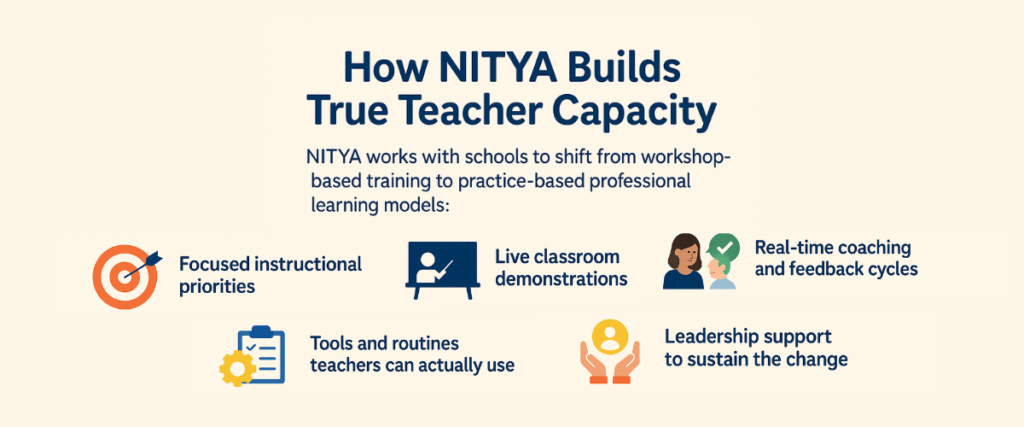
How NITYA Builds True Teacher Capacity
NITYA works with schools to shift from workshop-based training to practice-based professional learning models.
If your school is ready to move beyond one-time workshops and build long-lasting, confident teaching practice, we would be glad to discuss the right professional learning pathway for your context.
Reach out to us –www.nityatraining.com