

NEP 2020 (National Education Policy 2020) is India’s education reform framework focused on improving learning outcomes, promoting competency-based learning, supporting holistic student development, and modernising curriculum, assessments, and teaching practices across schools.
Since the introduction of the National Education Policy 2020, schools across the country have been navigating a mix of optimism and uncertainty. The policy promises more meaningful learning, reduced pressure on students, and better alignment with real-world skills. At the same time, it introduces new expectations around curriculum design, assessment, teaching practices, and documentation.
For many schools, the challenge is not resistance to change but interpretation. What does NEP compliance actually look like inside a classroom? How do guidelines translate into daily school functioning? And how can schools ensure they are moving in the right direction without overwhelming teachers or disrupting existing systems?
These questions are valid. NEP compliance is a gradual process that requires structure and sustained support. This guide is designed to help schools understand the core NEP rules and guidelines, recognise common pitfalls, and explore how digital systems can support compliance in a practical, sustainable way.
NEP 2020 Rules and Guidelines Schools Must Follow
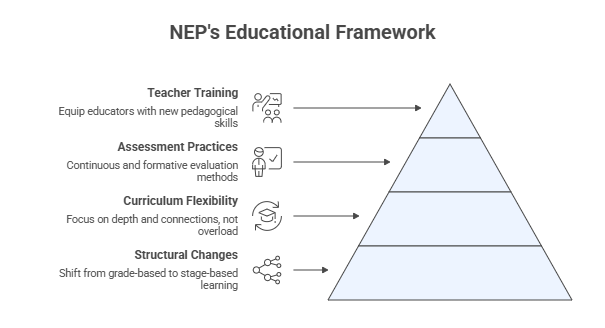
At its core, NEP lays down a set of expectations that redefine how schooling is structured, delivered, and evaluated. Understanding these rules is the first step toward meaningful compliance.
1. Structural changes in school education
One of the most significant shifts introduced by NEP is the move from a rigid, grade-based structure to a stage-based approach to learning. This change acknowledges that students develop cognitively at different stages and that teaching methods should reflect this progression.
For schools, this means thinking beyond annual syllabus completion. Academic planning needs to account for continuity across years. For example, concepts introduced in earlier stages should be deliberately reinforced and expanded upon later, rather than treated as closed chapters. Schools that plan learning in isolated grade-wise silos often struggle to demonstrate this continuity, which NEP now expects.
2. Curriculum flexibility requirements
NEP encourages schools to reduce content overload and focus on depth of understanding. Curriculum flexibility does not imply removing subjects or diluting standards. Instead, it requires schools to organise learning in a way that allows students to explore concepts more deeply and make connections across topics.
In practice, this might mean revisiting how lesson plans are sequenced or how much time is allocated to foundational concepts. Schools that rely solely on textbook-driven pacing often find it difficult to adapt, whereas those with structured curriculum planning systems are better positioned to align with NEP expectations.
3. Assessment and evaluation expectations
Assessment under NEP is no longer limited to end-term examinations. Schools are expected to adopt continuous and formative evaluation practices that reflect how students learn over time. This includes tracking depth of learning, skill development, and application, not just final scores.
For example, instead of waiting for annual exams to identify learning gaps, schools are encouraged to use regular formative checks to guide instruction. Solutions offered by NAVNEET TOPTECH, including assessment-focused platforms like TopAssess, support this approach by helping schools design evaluations that align with learning objectives while maintaining clear records of student progress.
4. Teacher training requirements
NEP places teachers at the centre of transformation. Compliance requires schools to ensure that educators are equipped to adopt new pedagogical approaches, integrate competency-based learning, and use academic tools effectively.
This goes beyond one-time workshops. Ongoing support through structured lesson planning tools, access to curated content, and clear frameworks plays a critical role in helping teachers translate policy into practice.
NEP Guidelines for Daily School Functioning
While rules define intent, guidelines shape everyday action. NEP compliance becomes visible in how classrooms operate and how learning is experienced on a daily basis.
1. Skill-based and competency-based learning
In classroom practice, NEP shifts the focus from syllabus coverage to activities that allow students to demonstrate competence. This requires schools to define learning outcomes clearly and ensure that teaching practices allow students to apply concepts rather than merely recall information.
For instance, a science lesson under NEP might prioritise problem-solving and observation over memorisation of definitions. Schools need systems that help teachers plan such lessons consistently and track whether competencies are being developed across classes.
2. Holistic student development
NEP recognises that academic performance alone does not capture a student’s growth. Emotional well-being, behavioural skills, and co-curricular engagement are equally important.
This expectation challenges traditional reporting methods. Schools are now required to document broader aspects of development, making comprehensive reporting structures essential. Platforms that support 360-degree report cards help schools reflect this holistic view without increasing administrative burden.
3. Experiential and multidisciplinary learning
Learning through experience and across disciplines is a cornerstone of NEP. This could include project-based learning, real-world problem-solving, or integrating concepts from multiple subjects into a single activity.
Implementing this consistently requires planning and coordination. Without structured systems, such initiatives often remain isolated experiments rather than institutional practices.
4. Inclusive education practices
NEP emphasises inclusion by recognising diverse learning needs and paces. A single teaching approach cannot serve all students equally. Schools must provide flexibility in how content is accessed and reinforced.
Personalised learning paths and differentiated resources help address this requirement, ensuring that no student is left behind while maintaining pedagogic standards.
Role of Technology in NEP Compliance
As NEP shifts schooling toward continuity, competency, and documentation, technology becomes an essential support system rather than an optional add-on. NEP compliance is not only about what schools teach, but also about how learning is planned, tracked, and sustained over time. Managing this level of complexity through manual processes alone is increasingly difficult.
Digital systems help schools translate NEP intent into daily academic practice by bringing structure and visibility to learning processes that would otherwise remain fragmented.
1. Digital tracking of student performance
NEP expects schools to demonstrate student progress across the stages of learning, not just at the end of the year. Technology-enabled tracking allows schools to maintain ongoing records of conceptual understanding, skill development, and engagement. Instead of relying solely on annual exam results, schools gain a clearer picture of how learning evolves over time, supporting both academic planning and accountability.
2. Managing assessments and learning outcomes
Under NEP, assessment is meant to guide learning rather than merely evaluate it. Digital assessment systems help schools align evaluations with learning objectives while maintaining organised records. Solutions from NAVNEET TOPTECH, including TopAssess, support this shift by enabling structured formative and summative assessments that provide meaningful feedback and actionable insight.
3. Supporting blended and online learning
NEP recognises that learning extends beyond the physical classroom. Technology platforms enable schools to support blended and online learning while maintaining consistency in content delivery and intellectual expectations. Students benefit from the flexibility to revisit concepts and learn at their own pace, while schools ensure continuity and documentation.
How the right LMS provider for schools supports NEP requirements
Meeting NEP expectations requires more than isolated digital tools. Schools need integrated systems that support curriculum planning, teaching execution, assessment, reporting, and communication within a single ecosystem.
An effective LMS provider for schools helps bring these elements together. Platforms like TopSchool, offered by NAVNEET TOPTECH, enable schools to organise curriculum delivery, support teachers through structured lesson planning and digital content, and maintain visibility across grades. When learning, assessment, and reporting are connected through one system, NEP compliance becomes more manageable and sustainable.
Rather than adding operational complexity, the right technology simplifies compliance by supporting people and processes already in place.
NEP Compliance Checklist for Schools
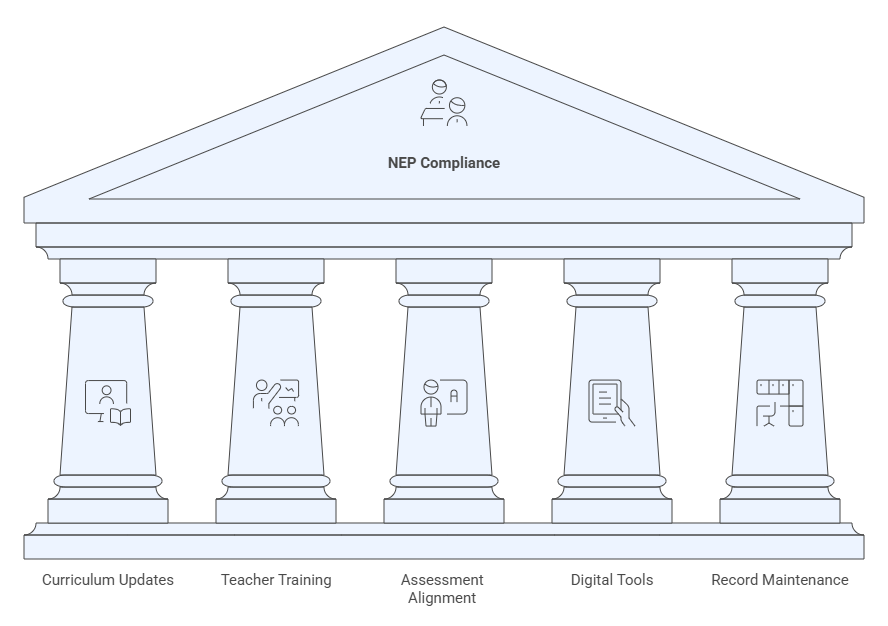
NEP compliance is most effective when schools regularly pause to review whether foundational elements are in place. Each aspect of this checklist plays a critical role in ensuring that policy intent translates into classroom reality.
1. Curriculum updated
Ensures learning remains relevant, balanced, and aligned with NEP’s emphasis on conceptual depth and flexibility. When curriculum updates are delayed or treated as cosmetic changes, teaching often continues in legacy patterns that conflict with NEP goals.
2. Teachers trained and supported
Enables consistent adoption of new teaching and assessment practices across classrooms. Without sustained teacher support, even well-designed curriculum reforms tend to remain theoretical, with uneven implementation from one classroom to another.
3. Assessment system aligned
Ensures evaluation reflects learning progression rather than isolated performance. Misaligned assessment systems often undermine NEP efforts by continuing to reward memorisation, even when classrooms aim to foster understanding and skills.
4. Digital tools in place
Supports the documentation, visibility, and continuity required for NEP compliance. In the absence of integrated digital systems, schools often struggle to track progress consistently, making compliance difficult to demonstrate and sustain.
5. Records and reports maintained
Helps schools monitor pedagogical development, identify gaps early, and plan informed interventions. Poor record-keeping weakens both internal review and external accountability, limiting a school’s ability to measure improvement over time.
Each of these elements contributes meaningfully to compliance only when implemented consistently. Overlooking even one can weaken the overall academic framework.
Building Sustainable NEP Compliance
NEP compliance is ultimately about improving the quality of education, not merely adhering to guidelines. Schools that approach it as a journey, supported by structured planning and appropriate systems, are better positioned to succeed.
By starting with small, intentional changes and gradually strengthening curricular processes, schools can align with NEP in a way that is sustainable, measurable, and meaningful. With the right digital support, NEP becomes less about compliance and more about creating confident learners prepared for the future.
FAQs
Q1. What are the NEP guidelines for schools?
The NEP guidelines encourage schools to focus on competency-based learning, holistic development, flexible curriculum design, continuous assessment, teacher training, and the effective use of technology to support learning outcomes.
Q2. What is the NEP syllabus?
The NEP syllabus focuses on conceptual understanding, critical thinking, skill development, experiential learning, and interdisciplinary education. It aims to reduce content overload and promote deeper learning rather than rote memorisation.
Q3. What are the main NEP rules schools must follow?
Key NEP rules include implementing competency-based education, adopting continuous assessment practices, supporting inclusive education, strengthening foundational learning, and ensuring teachers receive ongoing professional development.
Q4. What are the NEP 2020 guidelines for teachers?
The NEP 2020 guidelines for teachers encourage educators to use student-centred teaching methods, competency-based assessments, experiential learning approaches, and continuous professional development to improve classroom outcomes.
Q5. How do schools implement NEP 2020 effectively?
Schools can implement NEP 2020 by updating curriculum frameworks, aligning assessments with learning outcomes, providing teacher training, adopting digital learning tools, and regularly reviewing student progress and school practices.
Q6. Why is technology important for NEP 2020 compliance?
Technology helps schools manage curriculum delivery, assessments, student performance tracking, reporting, and communication more efficiently. It also supports blended learning and documentation required for NEP compliance.
Q7. What are the benefits of following NEP 2020 guidelines?
Following NEP 2020 guidelines can help schools improve student engagement, promote holistic development, strengthen foundational learning, support skill-based education, and create a more future-ready learning environment.