
India’s classrooms are in the middle of a quiet, powerful transformation. The National Education Policy (NEP) 2020 is the driving force behind it, reshaping a decades-old system into something far more agile, inclusive, and future-ready. The move from the familiar 10+2 model to the 5+3+3+4 education system reflects a global shift toward early foundational learning, skill development, and technology-enabled classrooms.
Digital tools are no longer optional accessories. Smart boards for classroom setups, Learning Management Systems, adaptive apps, and virtual labs now anchor the NEP vision. They help teachers deliver richer lessons, support students with personalised pathways, and make modern pedagogy easier to implement. NAVNEET TOPTECH is helping schools experience this shift not as a burden, but as an opportunity to build classrooms where students learn with clarity and curiosity.
Why Was the 5+3+3+4 Education System Introduced?
The older 10+2 format compressed very different developmental phases into two buckets. The new education policy 2020, breaks learning into developmentally coherent spans so pedagogy, assessment, and resources match how children actually grow. This means early childhood learning becomes experiential, middle years focus on skills, and secondary years prioritise choice and career readiness. The structure creates natural touchpoints for digital integration rather than forcing technology into a single, mismatched layer.
Understanding the 5+3+3+4 Education Structure
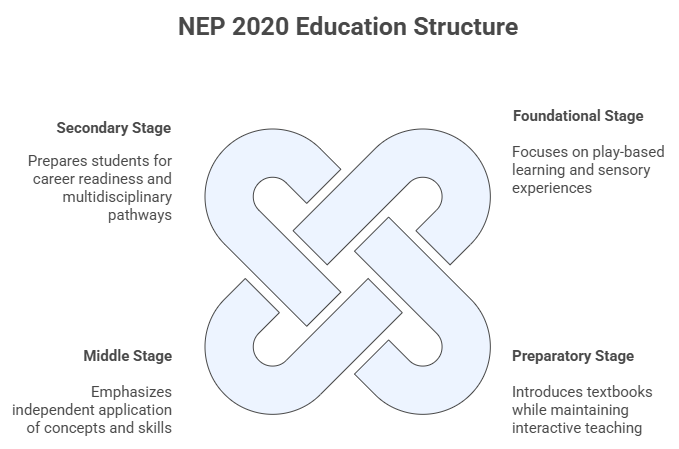
NEP 2020 breaks schooling into four developmental stages, each with a distinct purpose and pedagogical approach. Digital tools play a unique role in strengthening learning outcomes across all levels.
- Foundational Stage (5 Years | Ages 3 to 8)
This phase sets the emotional, cognitive, and linguistic base for all future learning. Since children learn best through play and sensory experiences, the NEP encourages environments that are interactive and curiosity-driven.
- Activity-based and play-based lessons
- Digital storytelling and phonics apps that make language learning intuitive
- Use of interactive screens and smart boards for classrooms that turn abstract concepts into visual experiences
- Tech-assisted literacy and numeracy tools that help children understand letters, patterns, and numbers naturally
Digital learning here makes early education joyful, guided, and developmentally aligned.
- Preparatory Stage (3 Years | Ages 8 to 11)
Textbooks formally enter the picture here, but the teaching style remains interactive and exploratory.
- Introduction of animations, videos, and visually rich content
- Gamified apps that help students build confidence in math and language
- Smart board activities that allow teachers to break down topics step-by-step
- Digital tools that support group activities and collaborative problem-solving
This stage bridges foundational play-based learning with more structured academic engagement while keeping lessons lively and accessible.
- Middle Stage (3 Years | Ages 11 to 14)
Students begin applying concepts more independently. This is where NEP’s emphasis on skills becomes obvious.
- Hands-on experiments and experiential learning
- Coding, robotics, and digital design introduced as part of regular learning
- Virtual labs that allow safe exploration of science concepts
- Technology-supported investigation that strengthens critical thinking
Classrooms become discovery spaces, where digital tools help students test ideas instead of memorising them.
- Secondary Stage (4 Years | Ages 14 to 18)
Flexibility and career readiness define this stage. Students can choose multidisciplinary pathways that match their interests.
- Digital research and online course modules
- Portfolios, projects, and real-world problem-solving
- Elective learning tracks supported by digital resources
- Internships and skill-building workshops that prepare students for college and industry expectations
By this point, students actively use technology to create, analyse, and innovate.
Why the 5+3+3+4 Structure Strengthens Digital Learning
The 5+3+3+4 structure creates purpose-built opportunities where specific technologies amplify learning outcomes. Here are four concrete mechanisms that explain how the structure makes digital learning effective.
- Age-appropriate technology mapping
Each stage has predictable cognitive milestones. That lets schools select tools that match development. For example, at the Foundational stage, a story-based phonics app plus a touch-enabled smart board for classroom activities improves letter recognition faster than paper drills. At the Middle stage, a basic robotics kit and a simulated virtual lab let students test hypotheses and internalise scientific methods.
- Chunked learning objectives that enable micro-adaptivity
The shorter stage windows allow schools to design micro-curricula and micro-assessments. An LMS can deliver 10-minute targeted revision modules after each concept, and analytics can route students into remedial or enrichment paths automatically.
- Clear assessment pathways that favor competence over recall
NEP’s move toward competency-based assessment pairs well with digital platforms that log skill mastery across time. Digital portfolios let teachers assess abilities beyond memory and recall.
- Scalable teacher enablement
The distinct stages of learning and teaching allows for modular teacher training. Early-years teachers can be trained in story-driven tech and classroom-management while the focus for secondary teachers can be research supervision and digital portfolio assessment. This focused approach reduces overwhelm and increases adoption.
Impact of Digital Learning on Students and Teachers
Digital learning is redefining how classrooms function. Its impact is especially visible in how it changes engagement, pace, and teacher-student dynamics aligning stage-specific digital interventions to the 5+3+3+4 structure.
For Students
- Attention and comprehension improve when visual and interactive elements replace passive lectures. This increases confidence, curiosity, and independent thinking.
- Skill progression becomes trackable. A child’s literacy level can be mapped month by month using phonics app metrics and correlated with teacher observations.
- Agency increases. With choice-driven elective modules in Secondary years, students demonstrate applied learning. Digital fluency develops early through exposure to coding, creativity tools, and research.
- Students in rural and urban settings gain access to the same high-quality content through LMS and local caches, reducing the rural-urban content gap.
Teachers
- Ready digital lesson plans reduce preparation time as teachers can curate standard digital lesson plans aligned to the stage outcomes and dedicate more towards classroom engagement and student mentoring.
- Real-time data helps teachers understand how each student is progressing. Teachers can access and monitor patterns through dashboards that flag students slipping on particular competencies so they can intervene and provide necessary support proactively.
- Professional identity shifts from knowledge transmitter to learning designer. Digital tools encourage collaboration, classroom participation, and smoother classroom management.
Practical Implementation Roadmap: How Schools Move from Paper to Practice
Change succeeds when it is incremental, measurable, and teacher-led. Here is a suggested six-month rollout for a mid-sized school adopting stage-aligned digital learning.
- Month 0 to 1: Needs audit and stage-mapping. Identify which classrooms will pilot Foundational, Preparatory, Middle, or Secondary interventions.
- Month 2: Tool selection and procurement. Prioritise one high-impact device per classroom such as a smart board for classroom and one LMS seat per teacher.
- Month 3: Intensive teacher workshops focused by stage. Run micro-certifications rather than weekend-long courses.
- Month 4: Pilot run in 4 to 6 classes, collect engagement and learning metrics.
- Month 5: Iterate content and workflow. Expand teacher coaching.
- Month 6: Scale to the full school using measured KPIs.
Key measurable KPIs to track from day one: lesson engagement time, concept mastery rate, homework completion rate, and teacher prep time reduction.
Roadblock and Challenges
Even with NEP’s strong push for technology, schools often encounter obstacles. The shift to digital learning requires planning, training, and phased adoption.
- Limited access to technology
Start gradually by introducing affordable digital tools like tablets or smart boards. Even a single device per classroom can significantly improve engagement. Start with shared devices and offline-first content, prioritising the highest-impact classrooms first.
- Teacher training gaps
Use peer coaching and stage-specific micro-certifications to reduce friction. Workshops, online modules, and continuous professional development help teachers understand how digital tools fit into pedagogy.
- Resistance to change
Pilot programs and real classroom success stories help teachers see the value of blended learning in action. Show immediate wins via short pilots with quantifiable improvements, then expand.
- Infrastructure gaps in rural settings
Implement hybrid offline-online models where content syncs when bandwidth is available.
Overcoming these challenges brings schools closer to realizing NEP 2020 expectations and unlocking the true power of digital classrooms.
How Smart Boards Accelerate NEP 2020 Implementation
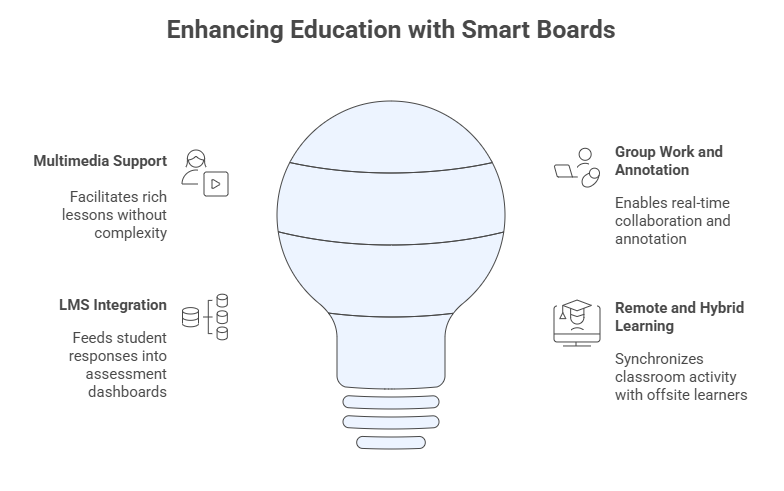
Smart boards are one of the most practical ways to bring NEP-aligned teaching into everyday classroom practice since they operate at the intersection of pedagogy and practicality. Smart boards turn classrooms into dynamic learning environments where students engage visually, mentally, and actively.
- They support multimedia-rich lessons without adding complexity for the teacher.
- They enable group work and annotation in real time which is perfect for Preparatory and Middle stage classrooms.
- They integrate with LMS, so student responses during class automatically feed into assessment dashboards.
- For remote or hybrid lessons, a smart board can be the single interface that synchronises classroom activity with offsite learners.
If schools must prioritise one classroom investment to make NEP’s goals tangible quickly, a well-integrated smart board plus teacher training is a high-return choice.
How NAVNEET TOPTECH Supports NEP 2020 in Classrooms
The nep 2020, 5+3+3+4 structure that matter for digital adoption are stage-aligned learning, competency-first assessment, EdTech encouragement, and mandatory early digital literacy. That policy scaffolding means digital learning is now a policy-aligned pathway to better educational outcomes.
Schools often understand NEP 2020’s goals but struggle to turn them into everyday practice. NAVNEET TOPTECH bridges that gap by aligning its digital tools, smart boards, and content ecosystem to the 5+3+3+4 structure. Teachers get stage-appropriate resources, interactive lessons, and simple workflows that make NEP’s vision, from foundational play-based learning to competency-led assessments, easier to implement.
With curated digital content, seamless classroom technology, and ongoing teacher support, NAVNEET TOPTECH helps schools create learning environments that are interactive, inclusive, and future-ready. In other words, it turns policy intent into practical, measurable classroom impact.
Conclusion
NEP 2020 outlines an exciting vision: flexible classrooms, stage-appropriate learning, digital fluency, and competency-led progress. The 5+3+3+4 education system creates logical points to insert the right technology, at the right time, with the right training. When schools pair stage-appropriate tools with teacher enablement and measurable pilots, digital learning shifts from an experiment to a system.
NAVNEET TOPTECH essentially becomes the operational engine that helps schools move from policy awareness to classroom-level execution, deliberately and measurably. The tools, training, and content work together to transform NEP 2020 from a document into daily practice.