

The NCERT new syllabus 2026-27 is the updated curriculum designed to make learning more conceptual, practical, engaging, and aligned with the objectives of NEP 2020.
Key Takeaways
- The NCERT new syllabus focuses on conceptual understanding rather than rote memorization.
- Primary classes will emphasize play-based, interactive, and activity-based learning.
- Middle school will focus more on interdisciplinary learning, experiments, projects, and vocational skills.
- Secondary classes will have greater emphasis on critical thinking, practical application, and subject flexibility.
- The updated NCERT books 2026 will reflect the changes in the revised curriculum.
- Schools and teachers will need to adapt their teaching methods and use of digital learning tools.
India’s education system is undergoing a major transformation and the recent introduction of the NCERT new syllabus is testament to it. The release of the new syllabus is firmly focused on making learning engaging, relevant, and away from rote memorization.
The new syllabus is rooted in the vision of the National Education Policy (NEP) 2020 as it primarily focuses on multidisciplinary, holistic, and flexible learning processes. The aim is to build the student’s critical thinking and help them understand concepts rather than memorizing chapters.
This new and updated syllabus affects teachers, students, administrators, and all stakeholders in education. And there is a need for schools to adapt to the new syllabus and everything it stands for.
What is the NCERT New Syllabus 2026-27?
In a move to make the country’s education future ready, the NCERT New Syllabus 2026-27 has brought about a complete overhaul in the NCERT curriculum.
Key Objective of this Overhaul:
- Eliminating the content overload and focusing on conceptual understanding over memorization.
- Encouraging activity-based education and experiential learning.
- Aligning education with 21st century global standards.
What are some major highlights of the new syllabus?
- Enhanced emphasis on multilingual learning
- Inclusion of digital tools throughout the learning process
- Introduction of life skills and vocational skills at an early stage
- Flexibility in subject choices
Major changes in the NCERT New Syllabus 2026-27
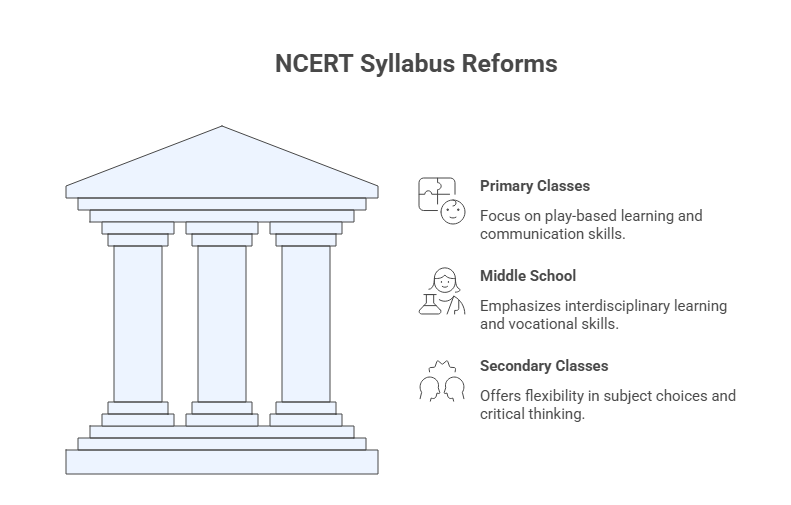
Changes in Primary Classes (1 to 5)
- More learning through play, interactive activities, and storytelling
- Reduced content to avoid overload on young mindis
- Enhanced focus on building the student’s communication skills
These changes are made to ensure that children fall in love with the process of learning and grow up to be curious, communicative individuals.
Changes in Middle School Education (6 to 8)
- Connected subjects to ensure interdisciplinary learning alongside real-world application for better understanding.
- Early introduction of vocational skills and hands-on activities to prepare learners for the future of work.
- Increased use of experiments, technology, and projects to boost experiential learning.
With this, students are pushed to understand concepts beyond textbooks and apply the gained knowledge practically.
Changes in Secondary Classes (9 to 11)
- The subject structure has been updated to allow better flexibility to students while making a choice for the stream they want to study.
- The ‘critical thinking’ focus ensures that real-world application is kept above theory and memorization.
- Subjects will now be designed in such a way as to ensure alignment with professional paths and higher education needs.
NCERT New Syllabus Books: What’s new in the Updated Textbooks?
The NCERT new syllabus books will reflect the changes in the syllabus and the curriculum.
What’s new in the books?
- The lessons in the books will be shorter and more focused on clear learning outcomes.
- The format of the chapters will also be more interactive, featuring activities, case studies, and real-life examples.
- Infographics, diagrams, and enhanced illustrations will make the textbooks visually engaging.
- Digital integration will be in focus with QR codes that will link to simulations, videos, and other additional resources.
These changes will make textbooks student-friendly, engaging, and they will also promote self-learning.
How will the NCERT curriculum changes impact schools and students?
For Students:
- Enhanced problem-solving and analytical skills
- Reduced burden of content overload
- Clearer understanding of concepts
For Teachers:
- Educators get to shift from traditional learning and can use interactive teaching methods.
- Teachers will also need to adapt and train in digital tools and experiential learning techniques.
For Schools:
- Schools will have to integrate technology into education with digital classroom solutions, LMS platforms, and more, provided by industry leaders such as NAVNEET TOPTECH.
- The focus will now be on application-based questions (bringing a major change in the approach to student assessment).
In summary, these updates will have the education ecosystem moving towards a much more meaningful and balanced education model.
NCERT Books 2026: Release Timeline and Implementation in Schools
In an attempt to ensure smooth implementation, the NCERT books 2026 will be rolled out in a phased manner.
What to expect?
- The phase-wise rolling out will ensure that the schools will transition step-by-step.
- The complete implementation of the new syllabus will be completed over a few academic cycles.
- The new syllabus will be gradually introduced across classes (starting with primary classes).
For parents and educators:
- Educators and guardians should stay updated with the latest announcements.
- Teachers should help students make sense of the new learning processes.
- The overall focus must now be on understanding and clarity rather than just on marks.
Conclusion
The world is changing rapidly and a country’s education must catch up. And the NCERT new syllabus has been introduced to do just that. After all, the focus is not just on new chapters and subject flexibility but on making students think innovative ideas, think critically, and get ready for a much-evolved future.
FAQs
Q1. What is the NCERT new syllabus 2026–27?
The NCERT new syllabus 2026–27 is the latest academic update introduced in line with NEP 2020. It focuses on reducing rote learning and encouraging concept-based learning, critical thinking, classroom participation, and practical understanding across grades.
Q2. What are the major changes in the NCERT revised syllabus 2026–27?
The NCERT revised syllabus 2026–27 brings several important changes, including lighter content load, more activity-based learning, stronger focus on communication and life skills, flexible subject choices, and better use of digital learning tools in classrooms.
Q3. Which classes are covered under the NCERT curriculum 2026–27?
The NCERT curriculum 2026–27 covers students from Grades 1 to 11 with changes introduced in phases. The updates are designed differently for primary, middle, and secondary classes based on age and learning requirements.
Q4. How is the NCERT new syllabus different from the previous curriculum?
The NCERT new syllabus focuses more on understanding concepts and applying knowledge in real-life situations. Compared to the earlier approach, there is less emphasis on memorisation and more focus on activities, projects, and classroom participation.
Q5. Will NCERT new syllabus 2026–27 books also be updated?
Yes, the NCERT new syllabus 2026–27 will also reflect in updated textbooks. Students can expect shorter chapters, clearer learning outcomes, practical examples, activities, and digital support like QR codes linked to additional learning resources.
Q6. How will the NCERT curriculum 2026–27 impact schools and teachers?
The NCERT curriculum 2026–27 will encourage schools and teachers to adopt more interactive teaching methods. Teachers may need to adjust lesson planning and use classroom technology to support activity-based and concept-driven learning.
Q7. Will NCERT books change in 2026-27 for Class 11?
Yes, NCERT books for Class 11 are expected to change as the new NCERT syllabus is implemented in phases. Students and schools should follow the latest official NCERT announcements for updates on revised textbooks and their availability.
Q8. What is new in the NCERT syllabus 2026-27?
The new NCERT syllabus focuses on conceptual understanding, activity-based learning, critical thinking, practical application, digital learning, life skills, and greater flexibility in subject choices across different grades.