School education has always been about shaping how students think, interact, and grow within society. It is where foundational habits of learning, discipline, and collaboration are formed, long before students begin preparing for careers or higher education. Over time, education systems have evolved to support this role, adapting methods and tools to remain relevant to the world students are stepping into.
As societies changed, education adapted with them. From traditional classroom instruction to the introduction of audiovisual aids, and later to digital learning tools, schools have continuously evolved to stay relevant to the world students are growing into. The recent rise of online learning further expanded access and flexibility, especially during periods of disruption. However, it also sparked an important conversation about what learning loses when it moves away from physical classrooms.
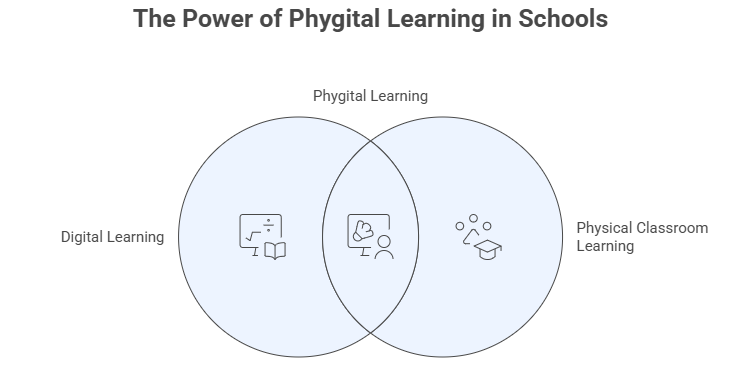
This is where phygital learning emerges as the future of school education and plays an important role in shaping modern phygital education models for schools. Phygital learning brings together the strengths of physical classrooms and the purposeful use of digital tools, creating learning experiences that are structured, interactive, and teacher-led. This blog explores what phygital learning means in the school context, how it benefits students academically and developmentally, why it is more effective than online-only learning, and how schools can strengthen classrooms through this integrated approach.
What Is Phygital Learning in School Education
Phygital learning refers to a classroom-based, teacher-led model where physical learning environments are enhanced through thoughtfully integrated digital tools. Students and teachers continue to interact in real time within shared phygital spaces, while technology supports explanation, practice, assessment, and reinforcement.
Unlike online-only learning, phygital learning does not replace classrooms or shift responsibility entirely onto screens. It builds on the structure, routine, and human connection of traditional schooling while enabling teachers to use digital resources to improve clarity, engagement, and consistency. Phygital learning places students within a community, where learning is shaped not only by curriculum but also by peer interaction, school culture, and teacher guidance.
In such learning environments, teachers observe student responses directly and adjust instruction as needed. Engagement is immediate and multi-dimensional. Students learn by listening, watching, responding, and participating. Classroom learning is not limited to information exchange. It is a dynamic process shaped by presence, interaction, and shared experience.
Benefits of Phygital Learning for Students
Phygital learning offers multiple benefits that support both academic understanding and overall development. These benefits become especially important during the formative school years, when students are still developing cognitively, socially, and emotionally.
- Conceptual clarity through guided instruction
One of the most significant benefits of phygital learning is better concept clarity through face-to-face teaching. Teachers can explain ideas in multiple ways, respond to confusion instantly, and build understanding gradually. Adaptive explanations based on student response leads to immediate doubt resolution. For example, when a mathematics concept does not land immediately, a teacher can reframe it using drawings, real-world analogies, peer explanation or even revisit it using different methods ensuring that learning gaps do not widen.
- Improved focus and discipline
Phygital classrooms retain the structure and routine that support focus and attention. Students follow shared timetables and learn within environments designed for learning, not distraction. Technology is introduced with purpose, under teacher supervision, reducing the cognitive overload and screen fatigue often seen in unstructured digital learning. The classroom atmosphere itself encourages accountability, helping students develop sustained attention and disciplined learning habits.
- Social and emotional skill development
Phygital learning continues to nurture social, emotional, and communication skills through daily classroom interactions. Group activities, discussions, and collaborative work help students learn how to express ideas, listen to others, and work through differences. These experiences are rooted in physical presence and strengthened through guided activities supported by digital tools. Peer interaction builds confidence and emotional connection to learning, making education an active, shared experience rather than passive content consumption.
Together, these factors lead to higher student engagement compared to online-only learning, where interaction is often limited and participation tends to be passive. Continuous interaction with teachers and peers also strengthens emotional connection to learning, keeping students engaged and invested in their education instead of receptive consumption of information.
Why Phygital Learning is More Effective than Online Learning
Online learning has introduced flexibility and access, but it also highlights clear challenges in the school context. Phygital learning addresses these limitations by keeping classrooms at the centre of education.
- Limitations of screen-based education
Learning can become passive in an online education system with students consuming content rather than actively engaging with it. Screen-based learning often makes it difficult for teachers to gauge understanding and engagement, especially with younger learners who are more prone to reduced attention span and screen fatigue. Teachers have limited visibility into student comprehension, making it harder to intervene at the right moment.
- Need for structure, routine, and discipline
Phygital learning preserves the structure, routine, and supervision that students need to learn consistently. Teachers guide the learning process, observe engagement levels, and respond immediately to hesitation or confusion. Digital tools support this process without requiring students to self-regulate prematurely. Classrooms provide stability, while technology enhances delivery and reinforcement.
- Role of classroom interaction in academic performance
Teacher questioning, peer discussion, and spontaneous clarification play a critical role in deepening understanding. In phygital environments, these interactions remain central, supported by digital resources that make learning more responsive and effective. This combination is why phygital learning consistently delivers stronger outcomes than online-only approaches.
Why the Future of School Education Lies in Phygital Classrooms
As classrooms prepare students for a world that is increasingly complex, interconnected, and technology-enabled, school education must evolve in ways that deepen learning. Phygital classrooms represent this evolution by responding directly to how students learn best in the present and how they will need to think, collaborate, and adapt in the future.
The future of education demands learning environments that balance human guidance with technological support. Phygital classrooms do this by keeping teachers at the centre of instruction while using digital tools to enhance clarity, continuity, and responsiveness. This ensures that learning remains contextual, adaptive, and anchored in real classroom experiences, rather than fragmented across disconnected platforms.
Phygital classrooms also prepare students for real-world application of knowledge. By combining discussion, digital exploration, collaboration and problem solving within the same learning environment, students learn to move seamlessly between thinking, doing, and reflecting. These are essential skills for future academic pathways and professional life.
Importantly, phygital learning supports scalability without compromising quality. Curriculum-aligned digital resources help standardise learning experiences across classrooms while allowing teachers to adapt instruction based on student needs. This balance of consistency and flexibility is critical for building resilient, future-ready education systems.
By strengthening classroom learning with purposeful technology, phygital classrooms create learning environments that are structured, engaging, and capable of evolving with changing educational needs.
How NAVNEET TOPTECH Strengthens Phygital Learning in Schools
NAVNEET TOPTECH is designed to support teacher-led phygital learning within classrooms. Our solutions integrate curriculum-aligned digital content into daily instruction, allowing teachers to enhance explanation, reinforce concepts, and assess understanding while keeping learning rooted in physical classrooms.
For early learners, PreK supports age-appropriate phygital experiences that combine hands-on classroom activities with guided digital interaction. This helps young students develop foundational skills through sensory engagement, visual learning, and structured teacher support.
NAVNEET TopSchool enables schools to deliver structured, curriculum-aligned learning across grades through digital resources that support classroom teaching. Teachers can use interactive content, assessments, and progress tracking tools to strengthen lesson delivery and monitor learning outcomes, all while maintaining classroom discipline and continuity.
Together, these solutions help schools modernise teaching practices while preserving the strengths of classroom-based learning.
To understand how NAVNEET TOPTECH can support your school’s classroom learning goals, explore our solutions designed specifically for teachers to be leaders in technologically facilitated classrooms.
Phygital Learning and NEP 2020 Alignment
NEP 2020 places strong emphasis on preparing students not just for academic success, but for meaningful participation in the world they will live and work in. The policy calls for learners who are emotionally aware, socially responsible, adaptable, and capable of applying knowledge in real-life contexts. Phygital learning environments play a critical role in enabling this vision. Classroom-based learning allows students to develop emotional awareness through everyday interactions.These experiences help students build social intelligence and self-awareness, which are essential for navigating a complex, interconnected world.
NEP 2020 also stresses competency-based learning over rote memorisation. Phygital classrooms support this by allowing teachers to observe skills as they develop, guide students through hands-on activities, and provide continuous feedback. When blended with curriculum-aligned digital tools, phygital learning becomes even more effective and also supports continuous phygital training for teachers to guide students through modern learning environments. Technology supports exploration, practice, and assessment, while teachers anchor learning in context and meaning.
Together,phygital learning supported by blended education helps schools nurture well-rounded learners who are academically capable, emotionally grounded, and prepared to grow into responsible global citizens, a core promise of NEP 2020.
The Best of Both Worlds
School education is ultimately about preparing students for life. Phygital learning remains central to this purpose because it brings together structure, human connection, emotional development, and academic depth in ways that cannot be fully replicated online.
As education systems continue to evolve, the question is no longer whether schools should adopt technology, but how thoughtfully it is integrated. Phygital learning offers a clear path forward. It preserves the strengths of classrooms while using digital tools to deepen understanding, support teachers, and align learning with modern expectations.By strengthening phygital classrooms rather than replacing them, schools can create learning environments that are resilient, relevant, and future-ready.
With the right support systems in place, phygital learning continues to shape confident learners who are equipped not only to succeed academically, but to engage meaningfully with the world around them.
FAQs
Q1. What are the benefits of phygital learning for students?
Phygital learning improves conceptual understanding, increases student engagement, supports social and emotional development, encourages collaboration, and helps students learn in a structured environment supported by technology.
Q2. How is phygital learning different from online learning?
Unlike online learning, phygital learning keeps classroom interaction at the centre of education. Teachers guide learning in person while digital tools enhance lesson delivery, assessments, and concept reinforcement.
Q3. How does phygital learning support NEP 2020?
Phygital learning aligns with NEP 2020 by promoting competency-based learning, critical thinking, collaboration, digital literacy, and holistic student development through a balanced use of classroom teaching and technology.
Q4. Why is phygital learning considered the future of school education?
Phygital learning combines the strengths of traditional classrooms with modern technology, creating engaging, interactive, and future-ready learning environments that support both academic achievement and skill development.
Q5. How does phygital learning improve student engagement?
Phygital learning combines classroom interaction with digital resources, making lessons more interactive and engaging. Students can participate in discussions, activities, quizzes, and visual learning experiences, which helps maintain attention and improves understanding of concepts.
Q6. Can phygital learning support personalised learning in schools?
Yes. Phygital learning allows teachers to use digital tools to track student progress, identify learning gaps, and provide targeted support. This helps create a more personalised learning experience while maintaining the benefits of teacher guidance and classroom collaboration.